Subscribe to Our Newsletter
To get the latest tips and news to support your well-being journey!
Find the right specialist for youFind a Specialist


You're looking for support, but you're not sure what kind. This is one of the most common questions I hear as a psychologist: “Do I need a life coach or a therapist?” Usually, people asking this question are not interested in professional labels. They simply want to feel better, move forward, make a decision, improve their confidence, or understand why they keep finding themselves in the same situations. The challenge is that coaching and therapy can look similar from the outside. Both involve conversations, both involve personal growth, and both can help you create positive change. Yet they serve different purposes.In my experience, choosing between coaching and therapy becomes much easier when you stop focusing on titles and start focusing on what you need right now. This article will explain the difference between a life coach and a therapist, who each approach is best suited for, and how to decide which type of support may help you most.
Think of coaching as a forward-looking conversation. A life coach helps people gain clarity, set goals, build confidence, and take practical action. The focus is not primarily on analysing the past. Instead, it is on creating meaningful change in the future. People often work with a coach when they know something needs to change but are unsure how to make it happen. They may want a career change, greater confidence, stronger leadership skills, better work-life balance, or a clearer sense of direction. On SympathiQ, coaching may include life coaching, executive coaching, and personal development support. You can explore available coaches through the Find a Coach → /find-a-coach page.
One of the biggest outcomes of coaching is momentum. Clients often move from feeling stuck and uncertain to feeling focused and motivated. A client who feels stuck in their career but is not experiencing depression might benefit more from a coach than a therapist. In this situation, the challenge is not emotional healing. The challenge is creating a plan, exploring options, and moving forward with confidence.Coaches typically work with people who are functioning well in daily life and want to move forward rather than people experiencing a crisis. The coaching relationship is often practical, structured, and focused on growth. nother common example comes from the workplace. Imagine a manager who is performing well but feels overwhelmed by increasing responsibilities. They are not experiencing anxiety that requires therapeutic support, but they struggle with delegation, confidence, and maintaining a healthy work-life balance.
In this situation, coaching can provide practical tools, accountability, and structured support. Rather than focusing on emotional healing, the work focuses on leadership development, communication skills, resilience, and sustainable performance. This is one reason coaching is becoming increasingly popular within corporate wellbeing programmes, where organisations want to support employee growth before challenges begin affecting performance or wellbeing.
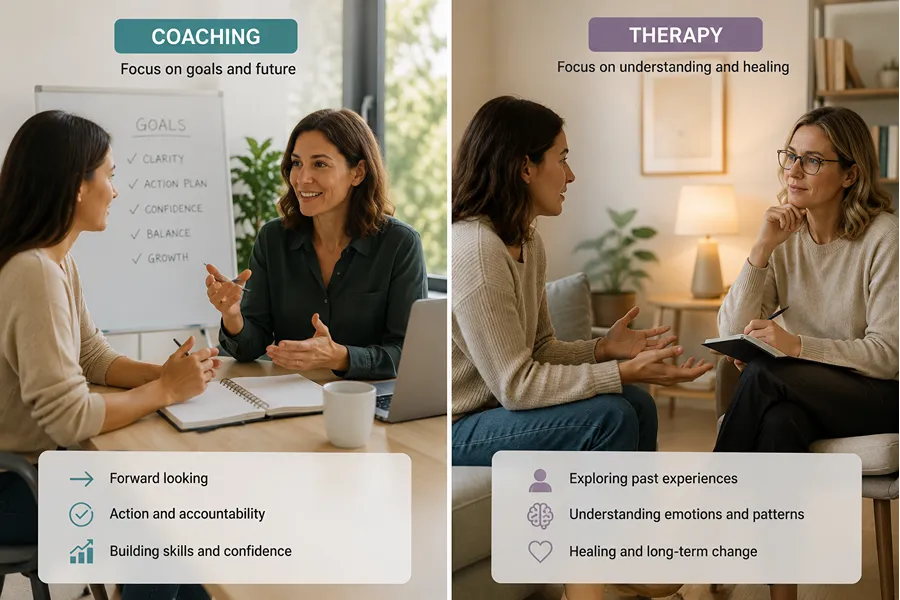
Therapy focuses on understanding and working through emotional experiences. While coaching often asks, “Where do you want to go?”, therapy is more likely to ask, “What might be getting in the way?” Many people come to therapy believing they need answers. They want someone to tell them what decision to make, whether a relationship can be saved, how to stop feeling anxious, or how to become more confident.
Yet what they often discover is that they do not need answers as much as they need space to understand themselves more clearly. Therapy can help people navigate anxiety, relationship difficulties, emotional patterns, low self-esteem, grief, and the impact of past experiences. It is less about finding quick answers and more about understanding yourself in a meaningful and lasting way.
Counsellors often provide shorter-term support focused on a specific issue. Therapists may work more deeply and over a longer period of time. The distinction is not always strict, but this is a useful general guide. Someone experiencing panic attacks, grief, or the aftermath of a difficult relationship is more likely to benefit from a therapist.
In my experience as a psychologist, many people discover that the issue they first describe is not the real issue at all. What looks like a confidence problem may actually be years of self-criticism. What looks like a motivation problem may be emotional exhaustion. All therapists on the SympathiQ platform are verified members of professional bodies such as BACP, UKCP, and BPS. You can browse verified therapists on the Find a Therapist /find-a-therapist page.
Life Coach | Therapist | |
Focus | Future goals and growth | Past patterns and emotional healing |
Best for | Feeling stuck, career, confidence | Anxiety, grief, trauma, relationships |
Typical length | 6-12 sessions | Ongoing, varies |
Regulated in UK? | No formal regulation | Yes - BACP, UKCP, BPS etc. |
On SympathiQ? | Yes - verified coaches | Yes - verified therapists |
If you are still unsure whether you need a life coach or therapist, these three questions can help.
Question 1: Are you looking to move forward, or work through something?
If your main goal is growth, direction, confidence, or achieving a specific outcome, coaching may be the right fit. If you feel that emotional experiences from the past are affecting the present, therapy may be more helpful.
Consider your sleep, eating habits, relationships, concentration, and work. If these areas are being significantly affected, I would generally suggest speaking with a therapist first. If not, coaching may be a good starting point.
Question 3: Have you tried talking about this before and felt you needed something more?
Many people have supportive friends and family. Yet they still feel stuck in the same cycle. If that sounds familiar, therapy may help you explore what is happening at a deeper level. There is no wrong answer - and it is always possible to switch, or work with both at the same time.
Can You Work With Both at the Same Time?
Absolutely. Coaching and therapy are complementary rather than competing. Some people work with a therapist to process emotions, understand patterns, and improve wellbeing, while working with a coach to set goals and stay accountable for change. For example, someone recovering from burnout might explore the emotional reasons behind their exhaustion in therapy while working with a coach to create healthier boundaries and a realistic plan for the future. This approach is becoming increasingly common in corporate wellbeing programmes and among people who want support in multiple areas of life. The important thing is not choosing the “perfect” option. The important thing is choosing the support that feels right for where you are today.
FAQs

Life coaching is not a regulated profession in the UK - anyone can call themselves a life coach. This is why using a verified platform like SympathiQ matters: every coach is credentialed and vetted before they can accept clients.
No. You can book directly with a private therapist without a GP referral. On SympathiQ, all therapists are verified professionals you can book with immediately - no waiting list, no referral required.
Life coaching sessions typically cost £60-£150 per hour with an independent coach. On SympathiQ, you can browse verified coaches, see their rates, and book directly - with no hidden fees.
Counsellors typically offer shorter-term support focused on specific issues. Psychotherapists are trained for longer-term, deeper work on underlying emotional patterns. Both are associated with professional bodies such as BACP and UKCP in the UK.
Coaching can be highly effective for people who want to build confidence in specific areas of their lives, such as leadership, career development, communication, or decision-making. If confidence difficulties are linked to deeper emotional experiences or long-standing patterns, therapy may also be worth considering.
Absolutely. Many people begin with coaching and later decide they would benefit from therapy, while others start with therapy and move into coaching once they feel ready to focus on future goals. The two approaches can work together at different stages of life.
A useful starting point is to ask whether you are trying to move towards a goal or work through something that is affecting your emotional wellbeing. If you are still unsure, you do not have to figure it out alone. SympathiQ's assessment /assessment and intelligent matching process are designed to help connect you with the most appropriate professional based on your goals, challenges, and preferences. In many cases, clients arrive unsure whether they need coaching or therapy, and the platform helps guide them towards the type of support that is likely to be most beneficial. The goal is not simply to find a professional, but to find the right professional for your specific situation.
Final Thoughts
If there is one thing I have learned from working with people over the years, it is that most of us wait far too long before reaching out for support. We tell ourselves we should be able to handle things alone. We hope the uncertainty will pass, the anxiety will disappear, or the relationship will somehow improve on its own. Sometimes it does. Often, it doesn't.
Seeking support is not a sign of weakness. It is often the moment people stop struggling in isolation and start moving forward with greater clarity and confidence. Whether you choose coaching, therapy, or a combination of both, the goal is not to become a different person. The goal is to better understand yourself, recognise what you need, and create a life that feels more aligned with who you are.
The most important step is deciding to get support at all. Whether that's coaching, therapy, or both - there is no wrong starting point. SympathiQ makes it easy to find a verified professional who is right for you.
Written by: Alona Perederiy, Psychologist, Positive Psychotherapist (WAPP), Graduate Member of the British Psychological Society (MBPsS), Founder Psychologist and Wellbeing Adviser at SympathiQ. With over 10 years of experience supporting clients through life transitions, anxiety, self-esteem challenges, and personal growth.

Your email address will not be published. Required fields are marked *