Subscribe to Our Newsletter
To get the latest tips and news to support your well-being journey!
Find the right specialist for youFind a Specialist


The best online therapy marketplaces for UK users in 2026 are SympathIQ, BetterHelp, Talkspace, Kooth, Counselling Directory, and Fresha — each built for a different need, from booking a verified therapist in minutes to free NHS-commissioned support for under-25s. The right one depends on whether you want therapy alone or therapy alongside coaching, nutrition, and fitness support, and whether you want to book instantly or browse a directory and make contact yourself.
Platform
| What it covers
| Pricing
| Booking
| Verification
|
| Therapists, life & career coaches, dietitians, fitness coaches, mental coaches — one platform
| Pay-per-session, no subscription (£4 platform fee + specialist's own rate)
| Instant — match and book in under 2 minutes
| Every specialist verified: credentials, accreditation body, experience shown on profile
|
| Therapy only
| Weekly subscription
| Matched via intake survey, days to first session
| Licensed therapists, matched by algorithm
|
| Therapy and psychiatry
| Subscription
| Matched via intake survey
| Licensed therapists and psychiatrists
|
| Therapy-adjacent chat support, mainly under-25s
| Free (NHS-commissioned in many UK areas)
| Drop-in chat or booked sessions with the Kooth team, not individual specialist choice
| NHS-commissioned service, qualified practitioners
|
| Therapist directory (UK) | Therapist directory (UK)
| Free to browse; therapists pay to list
| You contact the therapist directly — no built-in booking or payment
|
| General wellness and beauty bookings (massage, fitness, spa) — not therapy-specific
| Free to book; providers pay a marketplace fee
| Instant booking
| Provider-listed, not therapy-credential specific
|
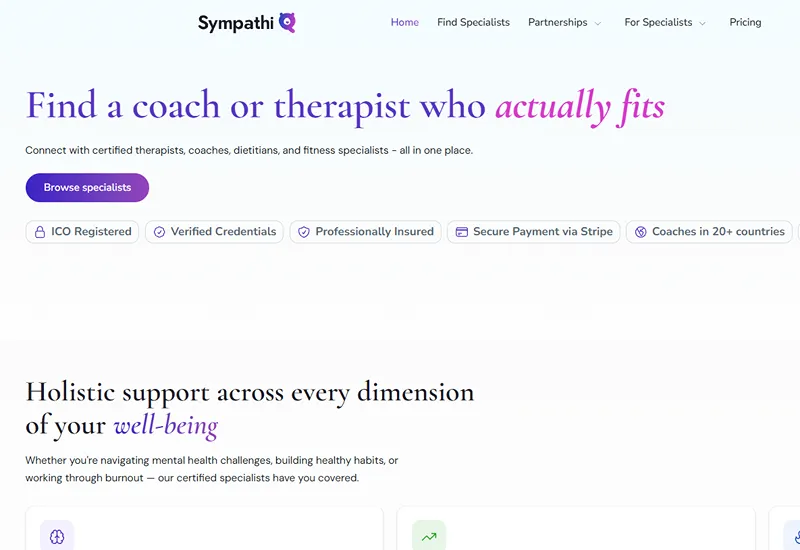
SympathIQ is the only platform on this list where you can book a therapist, life coach, career coach, dietitian, or fitness coach through the same account, in the same booking flow. There's no subscription — you pay per session, with a flat £4 platform fee shown upfront alongside the specialist's own rate. Every specialist is verified before they can take clients, with credentials, accreditation body, and experience visible on every profile, and matching typically takes under two minutes.
This makes it the better fit if what you actually need isn't purely clinical therapy — if stress, a career transition, or a health goal is part of the picture too, and you'd rather not manage separate bookings across several apps for each kind of support.
BetterHelp is the largest global subscription therapy platform, matching users to a licensed therapist through an intake survey rather than manual browsing. It's therapy-only — there's no coaching, nutrition, or fitness option — and billing is a recurring weekly subscription rather than pay-per-session, so cost doesn't scale down if you only need occasional sessions.
Talkspace covers both therapy and psychiatry (medication management), which sets it apart from most competitors on this list. Like BetterHelp, it's subscription-based and matches users via an intake process rather than direct specialist browsing.
Kooth is free to use and commissioned by the NHS in many parts of the UK, making it a strong option specifically for under-25s who want anonymous, low-barrier support. It's structured around drop-in chat and Kooth's own practitioner team rather than choosing and booking an individual specialist directly, so it serves a different need than a marketplace where you select who you see.
Counselling Directory is a well-established UK directory of therapists and counsellors — useful for browsing credentials and specialisms, but it's a listing service, not a booking marketplace. There's no built-in scheduling or payment; you contact the practitioner directly and arrange everything yourselves.
Fresha is a large UK booking marketplace, but it's built for massage, beauty, spa, and fitness bookings rather than therapy or mental wellness specifically. It's worth knowing about if you're also looking for adjacent wellness services, but it isn't a substitute for a platform built around verified mental health and coaching support.
Want therapy and coaching or lifestyle support in one place? SympathIQ is the only option here built for that combination.
Want a subscription with algorithm-based matching and don't mind paying weekly regardless of session count? BetterHelp or Talkspace.
Under 25 and want free, anonymous, NHS-commissioned support? Kooth.
Want to browse credentials and arrange things yourself with no platform fee? Counselling Directory.
Looking for general wellness bookings outside mental health specifically? Fresha.

A directory like Counselling Directory lists practitioners for you to contact yourself — there's no built-in booking or payment. A marketplace like SympathIQ or BetterHelp handles matching, scheduling, and payment in one flow.
Research generally shows comparable outcomes for many common concerns, though it depends on the individual and the type of support needed. Verified-specialist marketplaces let you check credentials and experience before booking, which matters regardless of format.
Not always. Subscription platforms like BetterHelp and Talkspace bill weekly regardless of how many sessions you use. Pay-per-session platforms like SympathIQ only charge when you actually book.
Most therapy marketplaces are therapy-only. SympathIQ is built specifically to cover therapists, life and career coaches, dietitians, and fitness coaches under one account.
This varies by platform. SympathIQ verifies every specialist's credentials, accreditation body, and experience before they can take clients, and this is shown on their profile. Directory-style platforms rely more on self-listed information.

Your email address will not be published. Required fields are marked *
Not every mental health marketplace offers the same value. Some simply gather names and profiles. Others create a more guided experience, helping users move from uncertainty to action with less guesswork.
The difference often comes down to three things: trust, clarity and continuity.
Trust starts with practitioner quality, but it goes further than credentials on a profile. People need to feel that the platform takes privacy seriously, explains how information is handled and creates a calm, secure experience from the first interaction. In mental health and personal growth, trust is not a bonus feature. It is the foundation.
Clarity matters because choice can quickly become overwhelming. More options are not always better if every profile sounds the same or if pricing is vague. A good platform helps users understand who each specialist works with, what kind of support they offer and what the next step looks like. That might mean filtering by issue, goal, availability, format or price point. It might also mean using plain, reassuring language rather than clinical jargon.
Continuity is where many platforms either prove their worth or fall short. Booking one session is helpful. Supporting an ongoing journey is far more valuable. People need simple ways to return, reschedule, track progress and stay connected to care over time. Lasting change usually happens through consistency, not a one-off appointment.
One of the strongest advantages of a mental health marketplace is the chance of finding a better fit. That matters more than many people realise.
Even a highly qualified professional may not be the right person for every client. Someone struggling with workplace burnout may want a practical, goal-focused style. Another person may need deeper therapeutic support for anxiety or grief. A couple looking for relationship guidance has different needs again. Better matching helps people find support that feels relevant, which can improve engagement and make it easier to keep going.
This is also where holistic platforms stand out. If somebody begins by seeking support for stress, they may later recognise that nutrition, movement, sleep or personal boundaries are part of the picture too. In that context, access to different kinds of specialists within one ecosystem can be genuinely helpful. It allows support to evolve as life changes, rather than forcing people to start from scratch each time.
There is a trade-off, of course. Broader platforms need to avoid becoming vague. If everything is offered to everyone, users may struggle to know where to begin. The strongest marketplaces solve this by making the journey feel guided rather than crowded.
If you are choosing a platform for your own wellbeing, convenience is only one part of the equation. The better question is whether the experience helps you take the next step with confidence.
Look for signs that the platform respects your time and emotional energy. Can you understand the specialisms quickly? Are session types and prices clear? Is availability visible? Can you book online without a string of back-and-forth messages? These details may sound small, but they shape whether support feels accessible or exhausting.
Privacy should also be easy to understand, not hidden behind vague promises. When people are seeking help for sensitive issues, they need confidence that their personal information and conversations are handled carefully.
It is also worth paying attention to the kind of support on offer. Some platforms focus narrowly on therapy. Others include coaching, nutrition, fitness and personal development alongside mental health services. Neither model is automatically better. It depends on what you need. If your challenges are interconnected, a more holistic approach may give you room to work on several parts of your wellbeing in a joined-up way.
The mental health marketplace is not only changing the client experience. It is reshaping how practitioners build and run their work.
For many specialists, the hardest part of private practice is not delivering care. It is everything around it: attracting clients, managing bookings, chasing payments and handling admin that eats into time and energy. A strong platform can remove much of that burden, allowing practitioners to focus more fully on the people they support.
That can be especially valuable for professionals who want to grow an online practice without piecing together multiple tools. A profile, calendar, payment system, client communication and virtual session setup all working together creates a simpler path. It also lowers barriers for skilled practitioners who may be excellent at care but less interested in marketing or operations.
There is a balance to strike here too. Practitioners want visibility, but they also want to retain their individuality and professional autonomy. The best platforms support both. They help specialists be found without flattening their approach into generic labels.
This is where many wellness platforms succeed or fail. People may arrive because they want speed and flexibility, but they stay because the experience feels supportive.
A thoughtful platform does not rush people into a booking before they understand their options. It helps them orient themselves, identify what they need and feel reassured about taking action. That sense of guidance matters when someone is already under pressure.
The strongest digital care experiences blend practical tools with emotional intelligence. They make it easy to compare professionals, but they also use language that reduces shame and uncertainty. They offer flexibility, but they do not make people feel as if they are navigating everything alone.
That is why the idea of an all-in-one wellness ecosystem has growing appeal. If someone can move from mental health support to burnout coaching, nutritional guidance or personal development within one trusted environment, the path to progress becomes less fragmented. For many people, that is not just more convenient. It is more realistic.
Platforms such as SympathiQ are part of this shift, creating spaces where care feels more connected, personalised and manageable for both clients and specialists.
A mental health marketplace is not a perfect answer to every challenge in care. Digital access helps many people, but it may not suit everyone. Some clients still prefer in-person support, and some needs require more intensive or specialist intervention than a marketplace can provide.
Choice can also become noise if the platform is not curated carefully. Too many profiles, too little differentiation and weak onboarding can leave users feeling stuck rather than supported. The technology matters, but thoughtful design matters just as much.
There is also a wider responsibility here. When wellbeing becomes easier to buy, platforms need to be careful not to oversimplify difficult emotional experiences or promise instant transformation. Good support can be life-changing, but it still takes time, honesty and the right fit.
The most credible marketplaces understand that tension. They make access easier without pretending healing is effortless.
A mental health marketplace works when it does more than help people book a session. It works when it gives someone a clearer starting point, a better chance of finding the right support and enough structure to keep going when life feels messy. If a platform can offer that with privacy, flexibility and genuine care at its centre, then taking the first step starts to feel possible - and sometimes that is the part that changes everything.
Not all support feels helpful just because it is available. The best online sessions for self-improvement do three things well.
First, they are specific. General motivation rarely lasts. Clear goals do. That might mean improving sleep over six weeks, building a steadier exercise routine, learning to manage stress triggers at work or communicating better in a relationship. A focused starting point gives the session shape.
Second, they are personalised. Advice that works brilliantly for one person can feel impossible for another. Your schedule, energy, finances, emotional capacity and previous experiences all matter. Good support takes those into account rather than handing you a one-size-fits-all plan.
Third, they create accountability without shame. There is a big difference between being pushed and being supported. Real progress often comes from gentle consistency - checking in, noticing patterns, adjusting goals and celebrating what is working instead of fixating on what is not.
One reason people give up on self improvement is that they choose the wrong format for the problem in front of them. If you are emotionally exhausted, a highly intense performance-based coaching style may leave you feeling worse. If you want practical habit change, reflective conversation alone may not be enough.
Mental health support can be helpful when anxiety, low mood, overwhelm or unresolved emotional strain are affecting daily life. Burnout coaching can suit professionals who are functioning on the surface but feel depleted underneath. Fitness coaching works best when you want structure, progression and someone to adapt a plan around your current level. Nutritional guidance can help if your eating habits are affected by stress, confusion or all-or-nothing thinking.
Personal development support sits slightly differently. It is often about confidence, boundaries, motivation, self-awareness and direction. For many people, that is the missing piece. They do not necessarily need crisis support. They need expert help to move from feeling stuck to feeling capable again.
Sometimes one area leads into another. Someone may start by wanting to improve productivity, then realise their real issue is chronic stress. Another person may seek help with fitness, then discover accountability and confidence are the bigger barriers. That is why a holistic approach tends to work better than treating every challenge in isolation.