Subscribe to Our Newsletter
To get the latest tips and news to support your well-being journey!
Find the right specialist for youFind a Specialist

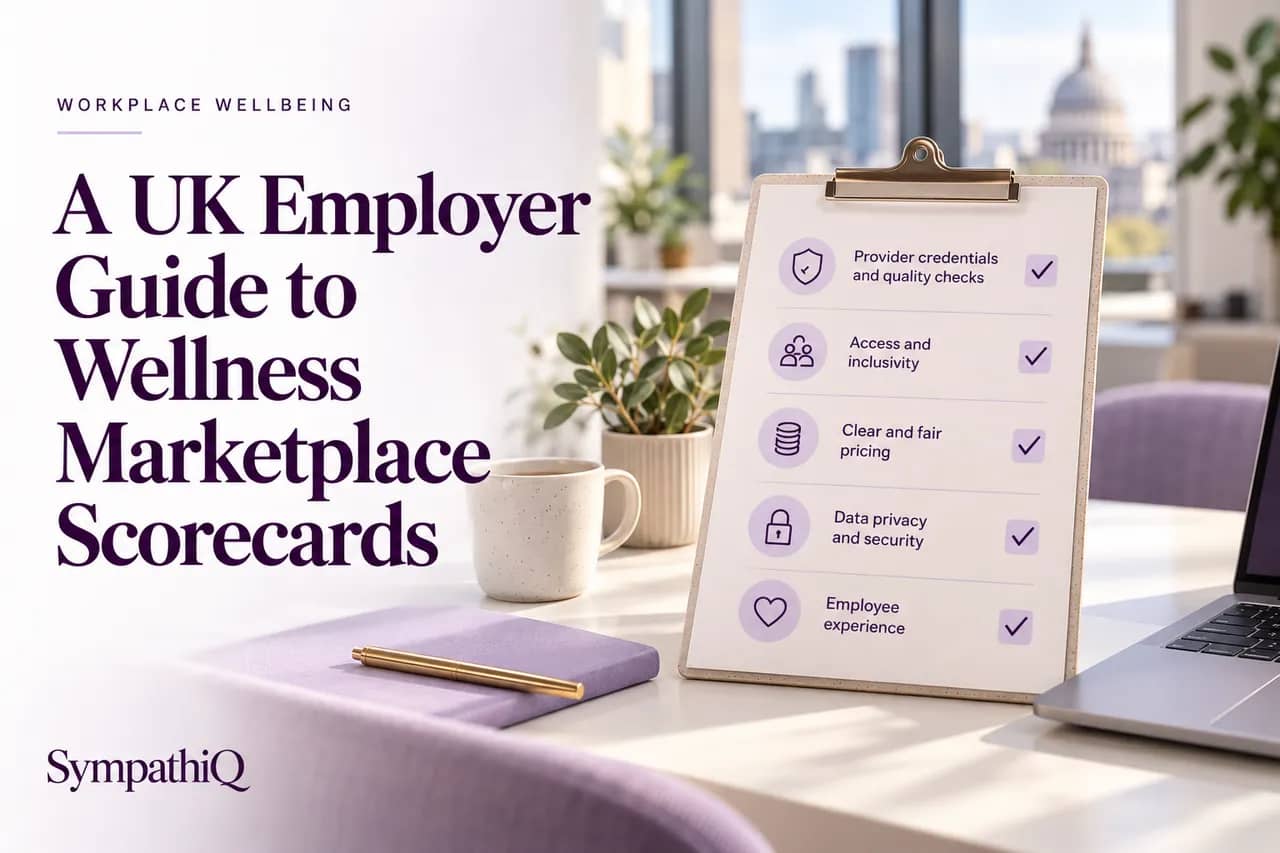
To compare employee mental health benefits marketplaces, score each provider from 0 to 3 against five weighted categories: clinical quality (30%), privacy and data protection (25%), access (20%), care integration (15%) and reporting (10%). Treat practitioner verification, UK GDPR compliance and a safeguarding pathway as pass/fail gates before any scoring starts. This guide gives UK HR teams the full scorecard, a worked example and the questions to put to every vendor.
Poor mental health costs UK employers an estimated £51 billion a year, according to Deloitte's May 2024 analysis. Presenteeism, where people work while unwell, is the largest share at around £24 billion. Deloitte also estimated that employers see a return of nearly £4.70 for every £1 invested in support. That is an average across many interventions, not a guarantee for any one product.
The operational picture is just as pressing. HSE's 2024/25 statistics show 964,000 workers in Great Britain reporting work-related stress, depression or anxiety, and an estimated 22.1 million working days lost to it. Employers must also assess the risk of stress-related ill health under the Management of Health and Safety at Work Regulations 1999. A benefit supports employees, but it does not replace that risk assessment.
Meanwhile, the market sounds the same from every angle. Marketplaces, employee assistance programmes (EAPs), apps and coaching platforms all promise "clinically led", "confidential" and "evidence-based" support. A scorecard turns those claims into evidence you can compare. It also gives HR, procurement, legal, IT and finance one shared basis for the decision.

An employee mental health benefits marketplace is an employer-sponsored platform that gives staff one access point to a choice of vetted practitioners and wellbeing services, such as therapists, counsellors, coaches and digital tools. Employees choose the provider and format. The employer sets eligibility, funding and reporting.
That model differs from the alternatives most UK workplace wellness platforms use:
Model | How it works | Typical strength | What to test |
|---|---|---|---|
EAP | One provider's helpline plus short-course counselling | Simple to administer, often bundled with advice lines | Practitioner choice and real utilisation |
Single-vendor app | One digital programme or tool | Scales cheaply, available at any hour | Fit for people with higher need, clinical escalation |
Marketplace | Many independent practitioners and services behind one front door | Choice of approach, language, format and price | Consistent quality and clear responsibility between platform and practitioner |
The last cell is why marketplaces need their own scorecard. Practitioners are often independent, so quality assurance depends on how rigorously the platform vets, supervises and monitors them.
Decide the category before you compare features. A mental health marketplace, a broad engagement platform and a preventative whole-person tool solve different problems, and a scorecard is only fair between providers that aim at the same one. This guide assumes you are buying mental health support.
Score every criterion from 0 to 3, using the same scale for every vendor:
0: no evidence, or fails the test.
1: claimed in sales material, with nothing to back it up.
2: evidenced, with gaps or caveats.
3: evidenced and independently verifiable (certificate, contract clause, audited report or named reference).
Criteria carry equal weight inside their category. Category weights then set the final score out of 100.
Category (weight) | Criterion | What a 3 looks like | Red flag (0 to 1) |
|---|---|---|---|
Clinical quality (30%) | Practitioner verification | Registration, qualifications, insurance and identity checks verified and re-checked at least yearly | Self-declared credentials |
Clinical quality (30%) | Clinical governance and supervision | Named clinical lead, documented governance, regular practitioner supervision, a complaints process | No clinical oversight beyond onboarding |
Clinical quality (30%) | Outcome measurement | Validated measures (for example PHQ-9, GAD-7, CORE-10 or WEMWBS) used routinely and reviewed | Satisfaction ratings only |
Privacy and data (25%) | UK GDPR and data roles | Written controller and processor split, data processing agreement, DPIA support, lawful transfer mechanism | Vague answers on who holds session records |
Privacy and data (25%) | Employer data firewall | Employer sees only aggregated data, with minimum group sizes | Individual names tied to usage |
Privacy and data (25%) | Security and records | Independent certification (such as ISO 27001 or Cyber Essentials Plus), encryption, breach process, retention schedule | No third-party assurance |
Access (20%) | Speed to first appointment | Median days from sign-up to first session published, with evening and weekend slots | Only "availability" claims |
Access (20%) | Choice and fit | Search by approach, language, gender, cultural background, specialism and format | Employees are assigned a practitioner |
Access (20%) | Inclusion and affordability | Accessible design, several languages, clear session pricing, defined cover for dependants | Unclear who pays for what |
Care integration (15%) | Safeguarding and crisis pathway | Written risk protocol, escalation route, signposting to NHS and crisis services, trained practitioners | Marketed as crisis support, or no protocol |
Care integration (15%) | Handover to NHS and specialists | Documented routes to the GP, NHS Talking Therapies and specialist care, with employee consent | Employee left to work it out alone |
Care integration (15%) | Fit with your wider support | Works alongside occupational health, manager training and return-to-work processes | Fully standalone |
Reporting (10%) | Utilisation and engagement | Monthly aggregate uptake by team or site, above a minimum group size | One annual PDF |
Reporting (10%) | Outcomes and impact | Aggregate outcome change, plus agreed absence or retention trends with the method stated | Testimonials as evidence |
Reporting (10%) | Commercial transparency | Fees, commission, contract exit and data return on exit set out in writing | Opaque pricing or lock-in |
Check these before scoring anyone. A fail on any one removes the provider from the shortlist, however well it scores elsewhere.
Verified practitioners: credentials checked by evidence, not self-declaration.
UK GDPR compliance: a signed data processing agreement and clear data roles.
Safeguarding protocol: a documented route for employees at risk, and honest messaging that the service is not an emergency service.
Counselling and psychotherapy are not statutorily regulated in the UK. Quality assurance therefore rests on professional registers and on the platform's own vetting. Practitioner psychologists are regulated by the HCPC, while many counsellors and psychotherapists join registers accredited by the Professional Standards Authority, such as BACP or UKCP.
Which registers do you accept, and how often do you re-verify membership, insurance and supervision?
Who is your named clinical lead, and what is their remit?
Which validated outcome measures do you use, and can you show anonymised aggregate results?
Red flag: "all our practitioners are qualified" with no checking process described.
Health information is special category data under UK GDPR, and the ICO has published guidance for employers on handling it. Consent is hard to rely on between employer and employee because of the power imbalance, so the safest design is one where the employer never receives individual-level health data.
Who is the controller for booking data, and who for session notes and clinical records?
Can you show the data processing agreement, hosting location and sub-processor list?
What is the minimum group size before a report is released to us?
Red flag: usage dashboards that show names, or reports small enough to identify one person.
What is the median time from sign-up to first session, and for which formats?
Can employees filter by approach, language, gender, culture and specialism before booking?
How do you serve shift workers, remote staff and people who prefer phone or chat to video?
Red flag: a large network headline number with no figure for bookable, active practitioners.
A marketplace for mental health support is not an emergency service, and it should say so plainly.
What is your written risk and escalation protocol, and how are practitioners trained in it?
How do you support a referral to the GP, NHS Talking Therapies or specialist care, with the employee's consent?
Can you work alongside our occupational health provider, manager training and return-to-work process?
Red flag: crisis support promised without a staffed, documented route behind it.
Which aggregate metrics do you report monthly, and at what minimum group size?
How do you show outcomes beyond satisfaction scores, and how do you state the method?
What do we receive when the contract ends?
Red flag: a single return-on-investment figure with no method behind it.
A wellness marketplace comparison only works if every vendor is judged the same way. Use this sequence:
Send every shortlisted vendor the same written questionnaire, built from the questions above, and ask for documents rather than descriptions.
Run the three gates. Remove any provider that fails one.
Have at least three people score independently: HR, someone responsible for data protection or IT, and a clinical or occupational health adviser. Discuss the gaps, then agree one score per criterion.
For each category, divide the points earned by the maximum available, then multiply by the category weight. Add the five results for a score out of 100.
Apply a floor: no category below 50% of its maximum, however high the total.
Take up two reference calls from employers of a similar size and sector, then run a short pilot before a full rollout.
As a guide, 80 or more is a strong fit, 65 to 79 is a shortlist with conditions written into the contract, and below 65 is a decline.
The two providers below are invented to show how the arithmetic and the floor interact.
Category | Weight | Provider A (% of max) | Provider A (points) | Provider B (% of max) | Provider B (points) |
|---|---|---|---|---|---|
Clinical quality | 30 | 80% | 24.0 | 60% | 18.0 |
Privacy and data | 25 | 90% | 22.5 | 70% | 17.5 |
Access | 20 | 60% | 12.0 | 90% | 18.0 |
Care integration | 15 | 40% | 6.0 | 70% | 10.5 |
Reporting | 10 | 70% | 7.0 | 90% | 9.0 |
Total | 100 | 71.5 | 73.0 |
Provider B edges ahead on total score, but the more useful finding is Provider A's care integration result. At 40% it breaches the 50% floor, so A should only proceed if the vendor commits in writing to close that gap. Provider B's weaker clinical score (60%) clears the floor, but it is the first thing to probe in reference calls.
These checks sit outside the scorecard but should be closed before contract. This is general information, not legal or tax advice, so confirm each point with your own advisers.
Tax treatment of UK employer benefits: HMRC's guidance on counselling for employees says employers have no tax, National Insurance or reporting obligations for qualifying welfare counselling. The service cannot include tax advice, and the benefit must be available to employees on similar terms. Since April 2020 the exemption also covers counselling that counts as medical treatment, such as CBT or interpersonal therapy. Reimbursing an employee instead of paying the provider directly can create a tax charge, and a bundle that mixes in non-qualifying services may too. Ask vendors to itemise what is included.
Data protection: Run a data protection impact assessment, set out your lawful basis, and tell employees plainly what you will and will not see. Special category health data calls for data minimisation, so ask only for aggregated reporting.
Health and safety duties: The Health and Safety at Work etc. Act 1974 and the 1999 Management Regulations cover psychological as well as physical health. Pair any benefit with a stress risk assessment, using the HSE Management Standards and, if you want a structured framework, ISO 45003, the voluntary guidance published in June 2021.
Contract terms: Insist on exit rights, return or deletion of data on exit, a sub-processor list, practitioner professional indemnity cover, and notification duties for data breaches and serious incidents.
They are employer-funded platforms that give staff a single access point to many vetted practitioners and wellbeing services, including therapists, counsellors and coaches. Employees choose who they see and how. The employer controls eligibility and funding and receives aggregated reporting only.
Use a weighted scorecard. Score each provider from 0 to 3 on clinical quality, privacy, access, care integration and reporting, apply pass/fail gates for verified practitioners, UK GDPR compliance and safeguarding, then convert the results to a score out of 100. Ask every vendor the same questions and request documents as evidence.
Ask who is the data controller for booking data and for clinical records, to see the data processing agreement, where data is hosted, and the minimum group size before reports reach you. Health data is special category data under UK GDPR, so employers should receive aggregated information only.
Often not. HMRC exempts qualifying welfare counselling that the employer provides or pays for directly and that is available to employees on similar terms. Tax advice is excluded, and reimbursing employees can create a charge. Bundled services may also affect the treatment, so check with your payroll adviser.
On the scale in this guide, 80 or more out of 100 is a strong fit and 65 to 79 is a conditional shortlist. Below 65, decline. Whatever the total, any category under 50% of its maximum, or a failed gate, should stop or delay a contract.
Not automatically. A marketplace can replace or complement an EAP, but check what you would lose, such as advice lines or manager support. It does not replace occupational health or your legal duty to assess stress risk. Score care integration to see how well it works alongside them.
SympathiQ runs a UK wellbeing marketplace, so we have an interest in this topic. We wrote the scorecard to be vendor-neutral and encourage you to score us with it too. SympathiQ is a non-clinical wellbeing marketplace, not a medical service, and it does not offer psychiatric or emergency care. Its specialists are members of professional bodies such as BACP and UKCP for therapists and ICF for coaches. For employer accounts, we design reporting to show registration status and aggregate usage only, never who booked or with whom.
Deloitte, poor mental health costs UK employers £51 billion a year (May 2024)
HSE, annual workplace health and safety statistics 2024/25 (20 November 2025)
Tax Journal, employer-provided welfare counselling (SI 2020/291)
Pennington Manches Cooper, ICO guidance for employers processing workers' health data

Your email address will not be published. Required fields are marked *


