Subscribe to Our Newsletter
To get the latest tips and news to support your well-being journey!
Find the right specialist for youFind a Specialist


The discussion about men and mental health often begins with assumptions. Men don't talk. Men don't seek help. Men bottle things up. The reality, however, is considerably more complex.
Before discussing why some men may be reluctant to seek counselling, it is worth looking at a few figures.
Around three-quarters of suicides in England and Wales are male. In 2022, 74.1% of registered suicides were men. [babcp.com], [ons.gov.uk]
Men account for only 32.6% of NHS Talking Therapies referrals, compared with 65.8% for women. [babcp.com]
The suicide rate among men remains approximately three times higher than among women. [commonslib...liament.uk], [ons.gov.uk]
In the latest figures, men aged 50-54 had the highest suicide rate among male age groups. [ons.gov.uk], [commonslib...liament.uk]
When men do access talking therapies, their outcomes are broadly comparable with those of women. In other words, therapy appears to work just as well for men who engage with it. [babcp.com]
Taken together, these figures raise an important question.
If effective support exists, why do so many men delay seeking it until difficulties have become severe?
The answer appears to be considerably more complicated than the familiar claim that men simply "don't like talking about their feelings."
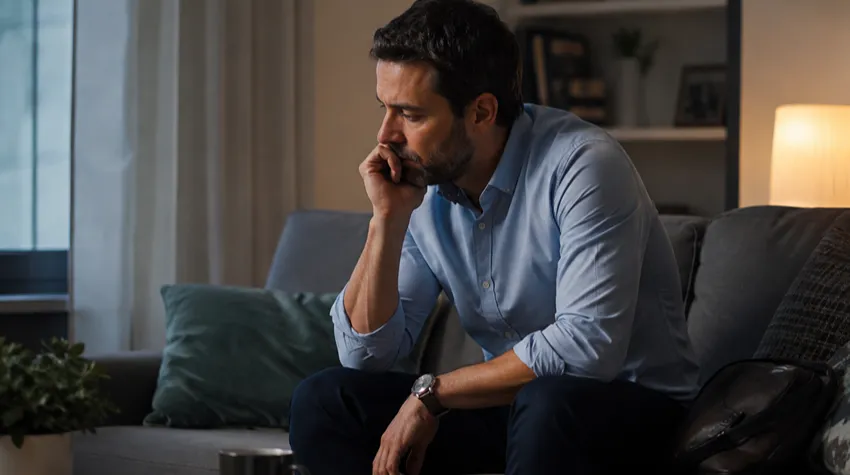
Many men are willing to talk about stress. They will discuss work pressure, financial worries, relationship difficulties, parenting challenges and exhaustion. They may openly acknowledge feeling overwhelmed, burnt out or unable to switch off.
Yet recognising distress and seeking professional support are not necessarily the same thing.
Research into men's help-seeking behaviour has consistently found that men are often more likely to delay accessing psychological support, frequently preferring to manage difficulties independently for as long as possible (Addis & Mahalik, 2003; Seidler et al., 2016).
This creates an interesting paradox.
Many men who would not hesitate to seek expert advice for a business problem, legal issue or physical health concern often feel less comfortable seeking support for emotional difficulties.
The issue is not necessarily a lack of resilience. In some cases, it may be resilience itself that delays help-seeking.
A substantial body of research has examined the relationship between traditional masculine norms and help-seeking behaviour (Addis & Mahalik, 2003; Vogel et al., 2011).
Traits such as independence, responsibility, competence and self-reliance are often encouraged from an early age. These qualities can be genuine strengths, helping people persevere, solve problems and carry responsibility during difficult periods. Difficulties arise when self-reliance becomes the only acceptable response to distress.
If strength is defined as coping alone, seeking support can feel uncomfortable. If competence forms a central part of identity, admitting struggle may feel uncomfortably close to admitting failure.
Seen through this lens, counselling may not be rejected because it lacks value. It may simply feel inconsistent with how some men believe they should respond to difficulties.
This distinction matters. A man can recognise that counselling is beneficial while simultaneously struggling to see it as something that applies to him.

Another challenge is language. Many men do not arrive at counselling saying: “I think I'm depressed.” or “I'm experiencing anxiety.”
For example, a man may initially seek support because he is becoming increasingly irritable at home, struggling to concentrate at work or feeling persistently exhausted. Only later does he recognise that anxiety, depression or burnout may be contributing to those difficulties.
The emotional problem is present from the beginning. It is simply described in a different language.
More commonly, they describe practical consequences:
I can't switch off.
I'm exhausted all the time.
I'm constantly stressed.
My temper is shorter than it used to be.
I'm struggling to concentrate.
Work feels overwhelming.
My relationship is suffering.
I don't enjoy things the way I used to.
These experiences may ultimately be connected to anxiety, depression, burnout or emotional distress.
However, they are often understood initially as practical problems rather than mental health problems.
This difference has important implications.
If counselling is primarily presented as support for people experiencing depression, anxiety or trauma, some men may simply fail to recognise themselves in the description.
They may not think:
“I need counselling.”
Instead, they may think:
“I need to get on top of my stress.”
Or:
“I need to stop feeling exhausted all the time.”
Or:
“I need to work out why everything feels so difficult lately.”
The destination may be the same.
The language used to get there is often different.
Many men compare themselves with somebody they imagine is “really struggling”. As a result, support gets postponed. The internal dialogue often sounds perfectly reasonable:
“It's not that bad.”
“Other people have it worse.”
“I'll deal with it when things calm down.”
“I just need to get through this period.”
The problem is that stress, anxiety and burnout rarely improve simply because they are ignored.
What begins as a temporary period of pressure can gradually become a way of life.
Sleep suffers.
Relationships become strained.
Patience becomes shorter.
Work becomes harder.
Life becomes something that is managed rather than enjoyed.
By the time support is finally considered, difficulties may already have become more entrenched than they needed to be.
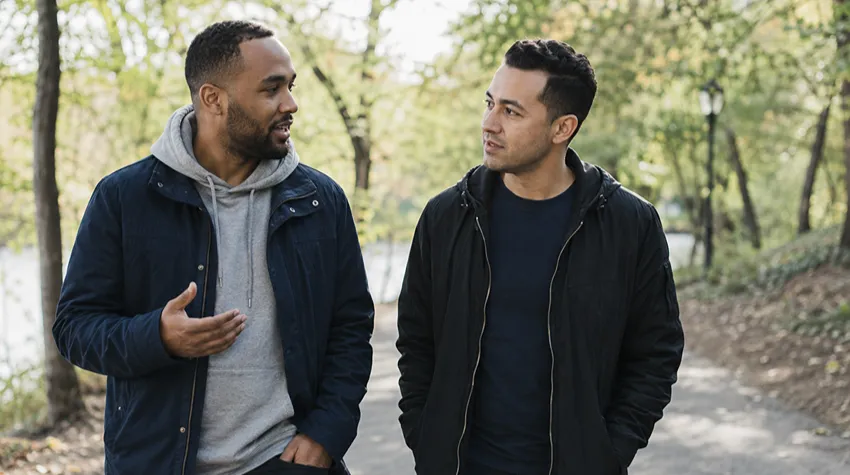
Not all barriers are psychological. For many men, particularly those balancing demanding careers, financial commitments and family responsibilities, practical considerations play a significant role.
Appointments during working hours can be difficult to attend.
Long waiting lists can reduce motivation.
Services may feel inaccessible or disconnected from the realities of everyday life.
This is one reason online counselling has become increasingly important.
For many people, the obstacle is not talking.
It's finding a realistic opportunity to start.
Removing practical barriers may therefore be just as important as reducing stigma.
Much of the public conversation focuses on why men do not seek therapy.
A more useful question may be whether the way therapy is presented influences who recognises it as relevant.
Counselling is often framed around emotional expression and vulnerability.
While those aspects are important, many men are motivated by goals that sound rather different:
Reducing stress
Preventing burnout
Improving relationships
Managing anxiety more effectively
Regaining balance
Sleeping better
Performing more effectively at work
Understanding recurring patterns
Feeling more like themselves again
These goals are not alternatives to counselling. They are often the very reasons people seek it.
Presenting counselling as a practical resource for understanding and addressing difficulties may feel more accessible than presenting it solely as a place to talk about feelings. The question is not whether therapy should become stereotypically masculine.
The question is whether services are describing what therapy can offer in language that more people recognise as relevant to their lives.
The phrase "men need to talk" is usually well-intentioned. The problem is that it oversimplifies a complex issue.
Men do talk.
They talk about work.
They talk about sport.
They talk about money.
They talk about relationships.
They talk about parenting.
They talk about responsibilities.
The more useful question may be whether men have spaces where difficult experiences can be explored honestly, without judgement and without the pressure to present themselves in a particular way.
Counselling is one such space.
Not because it requires men to become different people.
But because it provides an opportunity to examine challenges that might otherwise remain carried alone.
The evidence suggests that therapy can work for men when men access it. Yet large numbers continue to delay seeking support, often until difficulties have become overwhelming. [babcp.com]
Understanding this requires us to move beyond simplistic assumptions about men being unwilling to talk. The reality appears to involve a complex interaction of self-reliance, identity, language, accessibility, timing, cultural expectations and perceptions of what counselling is for.
Many men can recognise that counselling may be beneficial while simultaneously struggling to see it as something that applies to them. That distinction is important.
Perhaps the most productive question is not:
Why won't men come to therapy?
But:
What is it about the way we describe, present and offer support that means some men fail to recognise it as being for them?
Answering that question may do more to improve men's engagement with counselling than repeating, for another decade, that men simply need to talk.
Seeking support does not require a crisis. For many people, counselling is not about reaching breaking point. It is about understanding what is happening, regaining balance and preventing difficulties from becoming harder to manage in the first place.
British Association for Behavioural and Cognitive Psychotherapies (BABCP). (2025). Men account for three-quarters of suicides, yet they still struggle to access NHS therapies.
NHS England. (2024). NHS Talking Therapies for Anxiety and Depression, Annual Report 2023-24. (referenced within BABCP report). [babcp.com]
Office for National Statistics (2025). Suicides in England and Wales: 2024 registrations.
House of Commons Library. (2026). Suicide statistics. Research Briefing CBP-7749.
[commonslib...liament.uk]
Addis, M. E., & Mahalik, J. R. (2003). Men, Masculinity, and the Contexts of Help Seeking. American Psychologist, 58(1), 5-14.
Vogel, D. L., Heimerdinger-Edwards, S. R., Hammer, J. H., & Hubbard, A. (2011).“Boys Don't Cry”: Examination of the Links Between Endorsement of Masculine Norms, Self-Stigma, and Help-Seeking Attitudes. Journal of Counseling Psychology, 58(3), 368-382.
Seidler, Z. E., Dawes, A. J., Rice, S. M., Oliffe, J. L., & Dhillon, H. M. (2016). The Role of Masculinity in Men's Help-Seeking for Depression: A Systematic Review. Clinical Psychology Review, 49, 106-118.
Written by: Stuart Walker BSc (Hons), Dip.Couns, MBACP. Integrative Counsellor & Psychotherapist. Me In Time Counselling & Psychotherapy. MSc in Psychotherapy and Counselling at Bath Spa University

Your email address will not be published. Required fields are marked *