Subscribe to Our Newsletter
To get the latest tips and news to support your well-being journey!
Find the right specialist for youFind a Specialist

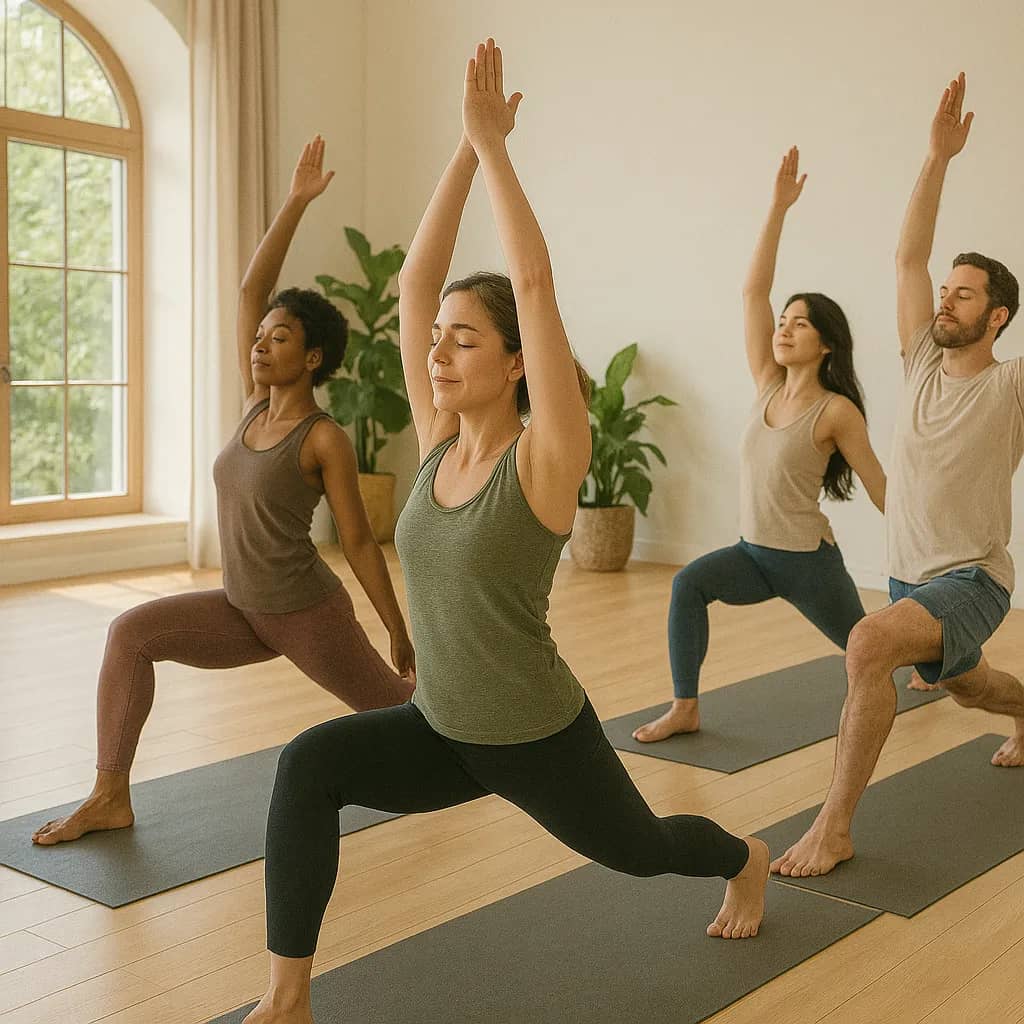
Online yoga classes let you practise at home with a teacher through a live one-to-one session, a live group class or a recorded video. For beginners, the best option is usually a class clearly labelled for beginners, led by an appropriately qualified and insured teacher who asks about injuries or health concerns and offers modifications.
You do not need to be flexible or own expensive equipment. A non-slip mat, comfortable clothing, enough clear space to move and a reliable internet connection are usually enough to begin.
Question | Short answer |
Are online yoga classes suitable for beginners? | Yes, when the class matches your experience and the teacher gives clear instructions and modifications. |
What equipment do you need? | Usually a non-slip mat, comfortable clothing and enough clear floor space. Blocks, a strap, cushion or folded blanket may help. |
Is live or recorded yoga better? | Live sessions offer interaction and possible form feedback; recorded classes offer more flexibility. |
How often should beginners practise? | Start with a manageable routine, such as one or two sessions a week, and increase gradually if it feels appropriate. |
Does yoga count as exercise? | Yoga can count as muscle-strengthening activity, depending on the style and intensity, but it may not meet all aerobic-activity needs. |
When should you seek advice first? | Speak to a GP or relevant health professional if you have a medical condition, injury, significant symptoms or concerns about starting exercise. |
An online yoga class is a guided yoga session delivered by video. It may be live, allowing you to interact with the teacher, or recorded, allowing you to practise whenever it suits you.
The main online formats are:
Format | How it works | Main advantage | Considerations | Best suited to |
Live one-to-one | You and the teacher meet by video at an agreed time | Personal attention and adaptations | Usually costs more than a group or recorded class | Beginners, specific goals and people who value direct guidance |
Live small group | Several students join the teacher in real time | Structure, shared energy and some interaction | Individual feedback may be limited | People who like scheduled classes and a group atmosphere |
Live large group | Many students join at once | Often offers a wider timetable | The teacher may not be able to observe everyone | Confident beginners or experienced students who follow verbal cues well |
Recorded class | You stream or download a pre-recorded session | Maximum flexibility; pause and replay | No real-time feedback or personal adaptation | Familiar movements, travel and unpredictable schedules |
If you are completely new to yoga, recovering from injury or unsure how to adapt movements, live guidance may be more appropriate than following a generic recording.
The strongest advantage of online yoga is practical: it can reduce travel time and make sessions easier to fit around work, caring responsibilities or an irregular schedule.
Depending on the style, level and consistency of practice, yoga can also support:
muscular strength;
flexibility and mobility;
balance and body awareness;
breathing awareness;
a regular movement routine;
time set aside to slow down and focus.
The NHS physical activity guidance lists yoga as a muscle-strengthening activity. However, it also explains that strengthening exercise does not always count as aerobic activity. Adults generally need aerobic movement as well, so yoga should be considered part of a broader activity routine rather than a substitute for every type of exercise.
Online delivery also has limitations. A teacher sees only what the camera shows, internet delays can affect communication and a recorded class cannot respond if a movement is unsuitable. The safest format is the one that fits your experience, needs and health status.
There is no single best style for everyone. Beginners should look at the pace, level, teaching approach and physical demands rather than choosing by name alone.
Yoga style | Typical approach | May suit | Check before joining |
Hatha | Often slower, with time to explore individual postures | Beginners who want a steady introduction | “Hatha” covers many teaching styles, so confirm the pace and level |
Beginner Vinyasa | Flowing sequences that link movement and breathing | People who enjoy continuous movement | Transitions can be quick; choose a genuine beginner class |
Yin | Mostly floor-based postures held for longer periods | People who prefer a quiet, slower session | Long holds are not suitable for every joint or condition; avoid forcing range |
Restorative | Supported, low-effort positions using props | People seeking a gentle, restful practice | Ask what props are required and whether the class includes breath practices |
Chair yoga | Movements completed seated or using a chair for support | People who prefer less floor work or need adaptations | Use a stable chair and check that the teacher understands your needs |
Pregnancy or postnatal yoga | Practice adapted for pregnancy or the postnatal period | Eligible participants seeking specialist guidance | Choose a teacher with relevant additional training and follow clinical advice |
Class labels are more useful than assumptions. “Gentle” does not automatically mean suitable for every health condition, and “beginner” should still include options to rest or modify.
Check the teacher’s training, experience, insurance and ability to adapt the practice—not only their social-media following or flexibility.
The UK National Careers Service lists professional-body training routes and notes that yoga teachers need insurance. It also highlights anatomy and physiology knowledge, experience practising with a qualified teacher and the ability to adapt positions for different needs.
Before booking, check the following:
Training: What yoga-teaching qualification did they complete, with which organisation and over how many hours?
Relevant experience: Do they regularly teach your level, age group or area of need?
Insurance: Do they hold current professional insurance for online teaching?
Health screening: Do they ask about injuries, pregnancy, medical conditions or recent surgery before the first session?
Adaptations: Can they offer alternatives without pressuring you to copy the deepest version of a posture?
Online setup: Will they explain camera position, privacy, sound and what they can or cannot assess remotely?
Class details: Is the level, pace, duration, group size, equipment and cancellation policy clear?
Professional boundaries: Do they communicate respectfully and avoid medical diagnoses or guaranteed results outside their competence?
Some teachers train through bodies such as the British Wheel of Yoga, Yoga Alliance Professionals or Iyengar Yoga UK. A professional-body name alone does not guarantee that a teacher is right for you, but transparent qualifications and relevant experience make comparison easier.
On SympathiQ, review each specialist’s stated qualifications, experience, focus areas, price and availability before booking. You can browse verified specialists and read how the platform approaches trust and safety.
Most beginner online yoga classes require very little equipment:
a yoga mat with suitable grip;
comfortable clothing that allows movement;
a clear, well-lit space where you can extend your arms and legs;
a stable device positioned so you can see the screen without repeatedly turning your neck;
a water bottle if needed;
optional blocks, a strap, a cushion or a folded blanket.
Remove loose rugs, cables, furniture edges and anything you could trip over. Avoid practising on a slippery surface. If the teacher will observe you, place the camera far enough away to show your whole body and ask whether a side or diagonal view is preferable.
You do not need specialist props immediately. Firm books may sometimes substitute for blocks, and a dressing-gown belt may serve as a strap, but improvised equipment must be stable and safe. Do not use a wheeled chair for chair yoga.
A well-run beginner class should explain the session format, ask about relevant limitations and remind you that resting is allowed. The teacher may introduce basic breathing awareness, gentle mobility, standing or floor-based postures and a short relaxation at the end.
Before the class:
join early enough to test the camera and sound;
tell the teacher privately about relevant injuries, symptoms or pregnancy;
ask whether the teacher can see enough of your body to offer feedback;
keep any suggested props within reach;
avoid placing the screen where you must twist to view it.
During the class, follow the version that feels stable and manageable. You do not need to match the teacher’s range of movement. A clear instruction should help you understand the purpose and direction of a movement without encouraging pain or competition.
Start with a frequency you can sustain and recover from. One or two beginner sessions a week may be enough to learn the basics; some people then add a short, familiar practice between taught sessions.
Progress is not measured by forcing deeper stretches. It can mean understanding instructions more easily, moving with greater control, using modifications confidently or maintaining a routine that fits your life.
The NHS advises adults to do strengthening activities for all major muscle groups on at least two days a week and to complete aerobic activity as well. The exact contribution of yoga depends on the style and intensity. A gentle restorative class, for example, will not create the same physical demand as a stronger flow.
If you are returning after a long break, begin gradually. More sessions are not automatically better if you are practising with poor form, ignoring pain or not allowing recovery.
Online yoga can be suitable for many people, but no exercise is risk-free. Remote teaching also limits what an instructor can observe or physically assess.
To reduce avoidable risk:
choose the correct level;
tell the teacher about relevant conditions or injuries;
keep movements within a comfortable, controlled range;
use support or a wall when balance is uncertain;
stop if a movement causes sharp, severe or increasing pain;
do not continue if you feel faint, unusually breathless, numb or unwell;
avoid advanced inversions, deep backbends or other unfamiliar high-risk postures without appropriate instruction.
The NHS recommends speaking to your GP before starting if you have not exercised for some time or have medical conditions or concerns. Seek urgent medical help for serious or sudden symptoms rather than using an online class to diagnose or treat them.
Pregnancy, the postnatal period, recent surgery, osteoporosis, significant joint problems and some cardiovascular, neurological or eye conditions may require specific guidance or adaptations. Tell the teacher and obtain advice from the relevant healthcare professional when appropriate.
Some people find yoga’s combination of movement, breathing and focused attention relaxing. It can be a useful wellbeing practice, but it should not be described as a guaranteed treatment for anxiety, depression, chronic stress or another mental-health condition.
Similarly, some people with back discomfort may benefit from suitable movement, while others need assessment or a different approach. Avoid a generic “yoga for back pain” video if pain is severe, follows an injury, is worsening or is accompanied by symptoms such as weakness, numbness, bladder or bowel changes, fever or unexplained weight loss. Seek appropriate medical advice.
A yoga teacher should stay within their professional scope. They may adapt movement and encourage you to seek medical input, but they should not diagnose the cause of pain unless they also hold an appropriate regulated healthcare qualification and are acting in that role.
Choose live yoga when feedback, accountability or adaptation matters most. Choose recorded classes when timing flexibility is the priority and you already understand the movements being taught.
A mixed approach may work well:
learn foundations in a live one-to-one or small-group session;
use short recordings to repeat movements the teacher has confirmed are suitable;
return to live sessions for progression, questions and updated adaptations.
Do not assume a live class guarantees individual correction. Ask how many people attend and whether students are expected to keep cameras on. If privacy matters, confirm the platform’s recording policy before joining.
SympathiQ connects clients with fitness, movement and wellbeing specialists who offer online appointments. Profiles display each specialist’s background, focus areas, session duration, price and availability so you can compare options before booking.
Start by browsing specialists. If you want broader exercise planning or personal training rather than yoga-specific guidance, read the online fitness coaching guide. You can also review pricing information before choosing a session.
Optional featured-specialist block: SympathiQ currently lists Sharon I., a movement and wellness specialist, whose profile includes yoga, Pilates, mobility and postural assessment. Keep this block only while the profile remains active and the services shown on the profile support the statement.
Yes. Choose a class explicitly designed for beginners and a teacher who explains movements clearly, asks about relevant health concerns and offers alternatives. A live small-group or one-to-one session can provide more interaction than a recording.
Most beginners need a non-slip mat, comfortable clothing, clear floor space and a device with a reliable internet connection. Blocks, a strap, a cushion or a folded blanket may be useful but are not required for every class.
A teacher may offer verbal feedback if your camera shows your full body clearly, but remote observation is limited by camera angle, lighting and video quality. Ask what the teacher can assess and do not rely on video as a medical or physical assessment.
Prices vary by format, teacher, class size, duration and experience. Recorded subscriptions and large groups are often structured differently from live private sessions. Compare the full price, cancellation terms and what support is included before booking.
One or two appropriately paced sessions a week can be a manageable starting point. Increase gradually if you are recovering well and the practice remains suitable. Consistency and good instruction matter more than forcing daily sessions.
Yoga can count as muscle-strengthening activity depending on the style and intensity. It may not provide enough aerobic activity on its own, so include other suitable movement as part of a balanced weekly routine.
Either can be beginner-friendly. Hatha classes are often slower, while Vinyasa links movements in flowing sequences. Check the actual class description, pace and level, because teaching styles vary.
Speak to a GP or relevant health professional if you have not exercised for some time, have a medical condition or injury, are pregnant or postnatal, recently had surgery, or are unsure whether the class is appropriate.
Online yoga works best when convenience is matched with suitable instruction. Choose a clear beginner level, verify the teacher’s training and insurance, prepare a safe practice space and use modifications without embarrassment. A sustainable practice should help you move with more awareness—not pressure you to perform or ignore symptoms.
Ready to explore your options? Find a SympathiQ specialist and compare credentials, focus areas, availability and prices before booking.
Your email address will not be published. Required fields are marked *