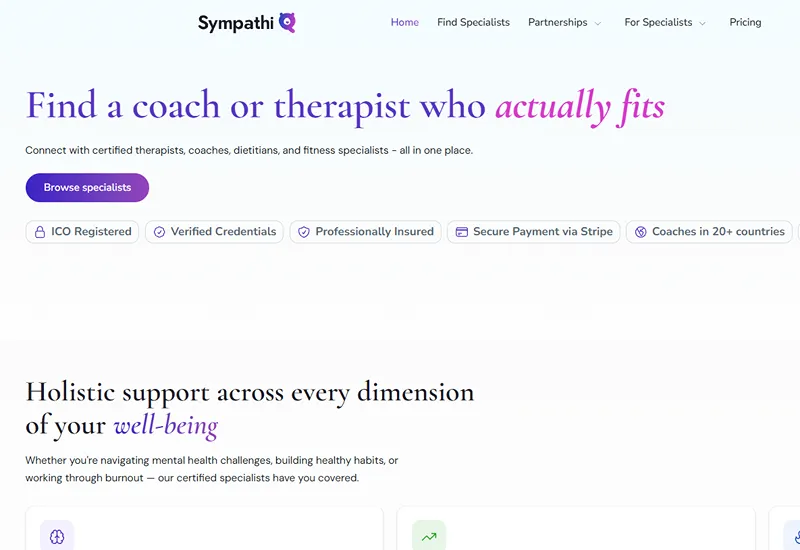
When considering what to know about UK wellness marketplaces, the most important things to know are specialist verification, transparent pricing, how fast you can actually book, whether the platform covers more than therapy alone, and what happens if it's not the right fit. Getting these five right matters more than which specific platform you pick, as a marketplace can look polished and still fail on the basics that determine whether you get real, reliable support.
The term gets used loosely. Some sites are single-category directories (therapists only, or coaches only) with "wellness" in the name for SEO reasons. A genuine multi-specialist marketplace lets you move between categories — say, a therapist and a nutritionist — without starting a new search from scratch each time. If your situation touches more than one area of wellbeing, that distinction saves real time.

This is the single most important thing to check before anything else. Before deciding which wellness marketplace to choose, it’s important to look for:
A stated verification process (credentials and identity checked before a practitioner can take clients, not just a self-submitted profile).
Professional body registration shown where relevant (BACP, HCPC, ICF, or the equivalent for the specialist type)
Insurance or indemnity cover disclosed, particularly for anything touching clinical or health-adjacent advice
Platforms that only ask practitioners to tick a box saying they're qualified are common — genuinely independent verification is rarer, and it's the difference that matters most.
"Wellness" spans a wide range: mental health therapy, life and career coaching, nutrition, fitness, stress and burnout support. A platform limited to one category means separate sign-ups and separate vetting each time your needs shift. Look for coverage across the categories you're actually likely to need, not just the one you need today.
Some UK wellness platforms are closer to a phone book: you find a listing, then message or call to arrange something yourself, with no guarantee of a quick reply. Others let you browse verified specialists and book a session directly, often in minutes. If you're searching because you want to act now, this is where platforms diverge most.
Check whether pricing is per-session or a recurring subscription, and whether the platform's own fee is separate from the specialist's rate or bundled in. Pay-per-session models with no ongoing commitment tend to suit people testing whether a specialist is the right fit before committing further.
A platform built for the UK market should reflect that in practice, not just in marketing copy — UK-recognised professional bodies, GBP pricing, and specialists who understand UK-specific context (NHS waiting times, UK employment norms around sick leave, UK insurance structures) rather than a US platform with a UK landing page bolted on.

Before choosing a UK wellness marketplace, confirm:
Practitioners are independently verified, not just self-declared
Relevant professional body registration is shown on profiles
The platform covers the range of specialists you might actually need
You can book directly, not just get a contact detail
Pricing is clear and you know if it's per-session or a subscription
The platform is genuinely built around UK practice, not a US site with a UK page added on
A directory lists practitioners for you to contact yourself, with no built-in booking or verification guarantee. A marketplace verifies practitioners and lets you book and pay directly through the platform.
It depends on the specialist type and the platform. Therapists should hold recognised registration (BACP, HCPC, or equivalent); coaching is less formally regulated, which makes independent platform-level verification more important. Check what a specific platform actually verifies rather than assuming regulation covers everyone listed.
Yes, on marketplaces built to cover multiple categories. This avoids needing a separate sign-up and vetting process for each type of support.
It varies. Marketplaces typically add a small platform fee on top of the practitioner's own rate; going direct avoids that fee but means doing your own verification. The trade-off is convenience and built-in vetting versus a marginally lower price.
Your email address will not be published. Required fields are marked *
Online counselling tends to work well for common but deeply important issues such as stress, anxiety, low mood, burnout, relationship strain, life transitions, and confidence challenges. It can also be a strong fit if you want structured support around emotional regulation, self-awareness, boundaries, or work-life balance.
For people who have busy schedules, online sessions make consistency much easier. And consistency matters. One good session can help, but lasting progress usually comes from showing up regularly enough to build trust, reflect, and practise new ways of thinking or coping.
It can also widen your options. Instead of being limited to whoever is based nearby, you may be able to find someone whose style, expertise, or approach feels more aligned with your goals. That can be especially valuable if you are looking for support that feels holistic rather than one-size-fits-all.
In some cases, online care also helps protect privacy. Not everyone wants to be seen entering a counselling practice or explaining repeated appointments to colleagues or family members. Quiet, discreet access matters, especially when you are taking a first step and feeling unsure.
People often talk about online counselling as if the main advantage is not leaving the house. That is part of it, but the deeper benefit is access without disruption. You do not have to choose between your wellbeing and the rest of your responsibilities quite so sharply.
That can reduce the emotional threshold of getting help. Booking a session feels less daunting when it can happen on your terms. If support feels easier to reach, you are more likely to follow through, and following through is often where change begins.
Affordability can also make a difference. Online counselling is not always cheaper, but it often cuts related costs such as travel, parking, childcare arrangements, or time away from work. For some people, those hidden costs are what make in-person support feel out of reach.
Another often overlooked advantage is continuity. If you travel for work, relocate, or simply have an unpredictable routine, online sessions can help you maintain momentum. That steadiness can be especially helpful during periods of high stress, when interruption tends to make everything harder.
There are real limits, and pretending otherwise is not helpful. Some people simply connect better in person. They read body language more easily, feel more grounded in a shared room, or find screens emotionally distancing. If you often struggle to engage on video calls, online counselling might feel harder rather than easier.
Privacy at home can also be a challenge. If you live with family, flatmates, or a partner and cannot reliably find a confidential space, it may be difficult to relax enough to talk openly. Counselling works best when you are not half-listening for footsteps outside the door.
Technology matters too. Poor internet, audio delays, or constant interruptions can break the flow of a difficult conversation. While these issues can sometimes be solved, they are not trivial when you are trying to discuss something personal.
There are also situations where a higher level of care may be needed. If someone is in immediate crisis, at risk of harm, or needs more intensive mental health support, online counselling alone may not be appropriate. The right support should match the seriousness of the need.
This is where the answer becomes more nuanced. Online counselling is not inherently better or worse than in-person support. It is better for some people, in some seasons of life, for some goals.
If you value flexibility, discretion, and easy access, online counselling may suit you far more than traditional appointments. If being in your own space helps you speak more openly, the online format could actually improve the experience.
If, however, you need the structure of leaving your environment, prefer richer non-verbal connection, or find screen-based communication draining, in-person sessions may feel more effective.
The key point is this: the best format is the one you can engage with honestly and consistently. A theoretically ideal option is not much use if you keep postponing it.
A better question than whether online counselling works in general is whether it supports your needs, personality, and routine right now.
Start with your practical barriers. If scheduling, travel, or privacy in public settings has stopped you seeking help before, online care may remove exactly the obstacle that has been holding you back.
Then think about how you communicate. Do you feel comfortable speaking on video or phone? Can you focus through a screen? Do you have a private place where you can be uninterrupted for the duration of a session? If the answer is mostly yes, that is a good sign.
It also helps to be clear about what you want support for. If you are looking for help with stress, burnout, relationships, low confidence, or emotional overwhelm, online counselling can be a very strong option. If your needs are more complex, it is worth checking whether the practitioner is experienced in that area and whether online work is appropriate.
Finally, pay attention to fit. Even the most accessible format will fall short if the relationship does not feel right. You should feel respected, safe, and understood. Good counselling is not just about availability. It is about connection, trust, and progress.
The sessions themselves matter, of course, but the surrounding experience matters too. Clear booking, transparent pricing, confidential systems, and a straightforward process all make it easier to keep going when motivation dips.
That is one reason platforms like SympathiQ can feel more supportive than a fragmented search process. When the journey from finding help to booking it is simple, secure, and aligned with your wider wellbeing goals, it becomes easier to take the first step and keep moving.
Worthwhile support should help you feel less alone with what you are carrying. It should create space for honesty, offer practical ways forward, and fit into your life well enough that change can actually happen.
Online counselling is worth it when it helps you access real support that you might otherwise postpone, avoid, or abandon. It is worth it when the format makes honesty easier, not harder. And it is worth it when the convenience leads to consistency, because consistency is often where healing, clarity, and growth begin.
You do not need the perfect setup to begin. You just need an option that feels safe enough, practical enough, and supportive enough to meet you where you are. If online counselling removes friction and gives you a realistic path towards feeling better, that is not a compromise. That is progress.
The most helpful next step is not asking whether online counselling is universally worth it. It is asking whether it could make support feel possible for you, now.
A therapist should be clear about their credentials, experience and areas of focus. If someone says they help with everything, that is not always reassuring. In most cases, the better sign is specificity. A therapist who regularly works with specific mental health conditions and uses evidence-based treatment approaches such as cognitive behavioural therapy is usually easier to assess than one who uses broad, vague language.
Two therapists can be equally qualified and still feel completely different to work with. That is why their therapeutic approach matters. Beyond credentials, a professional therapist should be registered with relevant professional bodies, follow strict ethical codes of conduct, and practice unconditional positive regard so clients feel accepted rather than judged. Some are structured and practical, helping you identify patterns and build coping strategies. Others are more exploratory, giving you room to reflect and understand deeper emotional dynamics over time.
Neither style is automatically better. It depends on what you need right now. If your life feels chaotic and you want tools you can use this week, a more goal-focused approach may feel grounding. If you have been repeating the same relationship patterns for years and want to understand why, a deeper reflective style might be more useful.
Read therapist profiles with this in mind. Notice how they describe sessions. Do they mention short-term support, long-term work, specific methods or collaborative goal setting? You can also discuss how they work, whether talking therapy is part of their approach, and whether their style feels collaborative enough to talk openly about your feelings. Do they sound warm but clear? Do you get a sense of what it would actually be like to speak with them?
A profile should help you picture the experience, not just display achievements.
This is easy to dismiss when you are booking online, but emotional safety matters from the first interaction. Before you have even had a session, ask yourself whether the therapist or platform makes things feel understandable and contained.
Are fees transparent? Is it easy to see availability? Are privacy standards explained clearly? A good online therapist or platform should explain confidentiality, consent, and how client information is stored or shared, since therapists are legally bound by confidentiality laws and should not share client information without consent. Secure online therapy services should use HIPAA-compliant systems because data breaches can expose sensitive therapy information, and many platforms offering mental health services also let clients review data-collection settings or opt out before booking. Do you know what type of session you are booking and how communication works? When those basics are muddy, it can add stress before the work even begins.
Feeling safe also includes cultural and personal fit. You may want a therapist who understands your identity, cultural background, faith, sexuality, neurodivergence or lived experience. That is not being too picky. It is often central to whether clients feel seen. If something matters to your comfort, let it matter in your search.
It is tempting to compare therapists like products, but therapy is not a feature checklist. Price, availability and specialism matter, of course, yet the real question is whether this person seems equipped to support your particular mental health needs.
Start by narrowing your options to two or three people who meet your practical needs. Then compare them on four things: relevance, style, clarity and comfort. Relevance means their experience aligns with what you want help with. Style means their way of working sounds suitable for your personality and goals. Clarity means they explain how online therapy work in a way that makes sense. Comfort is more intuitive - do you feel at ease reading their profile, or do you feel put off without knowing why?
Studies show online therapy outcomes are equal to in person therapy for many people, which is why fit still matters when comparing options.
That last part can be surprisingly useful. You are not looking for a best friend, but the relationship does need to feel workable. If someone sounds too cold, too vague or too intense for where you are right now, it is fine to move on. And if your first therapist is not the right fit, switching is often simpler online.
Online therapy often appeals because it can be more flexible and affordable than in-person care. Even so, cost can still be a barrier. It helps to be realistic. In the UK, private therapy is a useful benchmark, since traditional care can cost about £80 to £100 per hour, while some therapy sessions online start from roughly £36. A lower fee is only helpful if you can stay consistent, and a higher fee is not worth it if the therapist is not a good fit.
Try to think in terms of sustainable support. Could you afford sessions weekly, fortnightly or only occasionally? Would shorter-term focused support be more realistic for now, especially if long NHS waiting times make faster support feel important? Pricing models also vary across platforms: Talkspace starts at $69 per week, BetterHelp is about $70 to $100 per week, and E-Therapy Cafe charges $55 for a first session and $65 after that. Some people do better with regular lower-cost sessions, while others prefer fewer sessions with more self-directed work in between.
Some online therapy services are in network or accept insurance, which can change the total cost. The right choice is not always the cheapest or the most expensive. It is the one you can maintain without adding financial strain to emotional strain.
You do not need to interview a therapist like a hiring manager, but a few thoughtful questions can save time. You might want to ask how they usually work with people facing your kind of issue, whether they offer short-term or open-ended support, what a first session normally covers, and whether they begin with an assessment or consultation and tailor treatment to your symptoms.
If you are using a platform, also look at the practical side. Can you book and manage appointments easily? Is the technology straightforward? Are online therapy sessions secure and private, and do they happen by video calls or phone? Being able to join from your own home also removes the need to travel to appointments. If weekday booking is hard, check weekend availability too. Convenience may sound secondary, but when support fits around work, family life and daily routines, you are more likely to keep showing up and keep access simple.
That is one reason integrated platforms can help. If you are exploring support across mental wellbeing, burnout, nutrition or wider personal growth, having everything in one place can reduce friction. SympathiQ, for example, is built around that more holistic experience, helping people find support that fits real life rather than forcing every need into a single box.
Many people assume they must commit after one booking. You do not. The first session is not only for the therapist to understand you - it is also for you to assess them. You can also ask which evidence-based psychotherapy approach they use, whether that support is likely to fit your specific mental health conditions, and how they would tailor treatment to your needs.
Notice whether they listen well, explain things clearly and make room for your goals. Do you feel rushed, judged or managed, or do you feel heard and gently guided? A good therapist does not need to say exactly what you want to hear, but they should make it easier to be honest. Many therapists specialise narrowly rather than generally, sometimes across more than 150 areas, which matters if your symptoms are complex.
Some discomfort in a first session is normal. Therapy can feel vulnerable, especially online where people worry about connection and rapport. But there is a difference between vulnerable and unsafe. If you are seeking help for anxiety and depression, ask how they work: cognitive behavioural therapy is a common evidence-based option for anxiety, but the right treatment still depends on fit and goals. If something feels consistently off, trust that. Fit is not a luxury. It affects outcomes.
If the first session feels promising but not perfect, that is often fine. Rapport can take a little time. You may need two or three sessions to know whether the approach suits you. But if you leave feeling more confused than supported, or if the therapist seems misaligned with your needs, it is reasonable to try someone else.
If your first therapist is not the right match, switching online is often easier than with many offline services.
Switching is not failure. It is part of finding the right support. The aim is not to prove you can tolerate a poor fit. The aim is to create the conditions where progress is possible.
Online therapy works best when it feels both accessible and personal. A good online therapist should make it easier to access therapy in a way that fits your life. Depending on the platform, that may include regular sessions plus ongoing support options such as unlimited messaging. You want convenience, yes, but also trust. You want flexibility, but not vagueness. Most of all, you want support that meets you where you are and helps you move forward at a pace that feels manageable.
Take the first step with curiosity rather than pressure. The right therapist online is rarely the one with the flashiest profile. It is the one who helps you feel understood enough to begin, especially if starting in person can feel impossible.