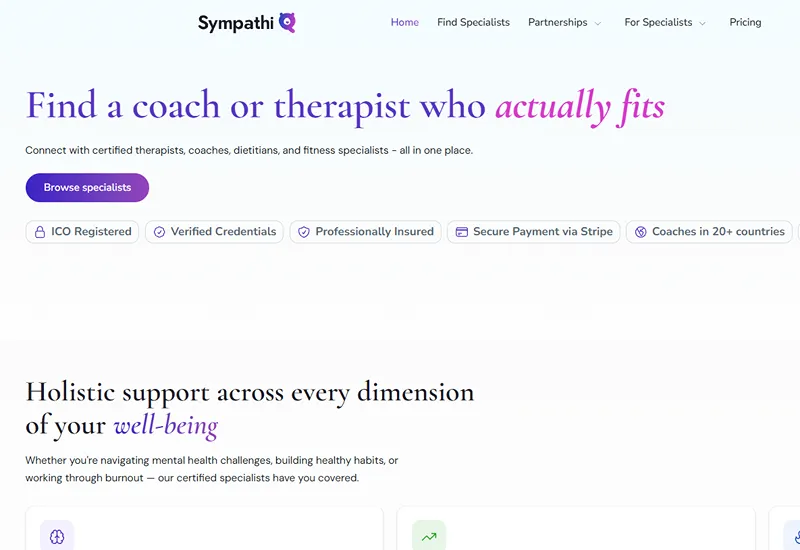
The most important things to look for in an online therapy marketplace are specialist verification, transparent pricing, how fast you can actually book, whether the platform covers more than therapy alone, and what happens if it's not the right fit. Getting these five right matters more than which specific platform you pick — a marketplace can look polished and still fail on the basics that determine whether you get real, reliable support.
Not every platform checks credentials the same way. Before you book, look for:
Named accreditation bodies (not just "licensed" without specifics)
Years of experience shown on the profile, not just a star rating
A verification process that happens before a specialist can take clients, not after complaints roll in
Directory-style sites often let practitioners self-list without independent verification. A marketplace that and displays them on every profile gives you something to actually check, not just trust.
This is where costs quietly add up. Subscription platforms bill weekly or monthly regardless of how many sessions you actually use — fine if you want frequent, ongoing sessions, expensive if you only need occasional support. Pay-per-session platforms charge only when you book, with the fee structure shown upfront before you commit.
Ask specifically: is there a recurring charge if I don't book anything this week? If the answer isn't immediately clear on the , that's itself a signal.
Some platforms route you through an intake survey and a multi-day matching process before you see a single specialist. Others let you browse verified profiles and book directly — often in a couple of minutes. If you're reaching out because you need support now, the difference between "book instantly" and "wait for a match" matters more than most other criteria on this list.
Most online therapy marketplaces are exactly that — therapy only. But a lot of what people are actually dealing with sits across categories: stress that's really about a career decision, burnout that would benefit from both therapy and a life coach, a health goal that needs a dietitian as much as a counsellor. Look for whether a platform can cover:
Therapists and counsellors
Life and career coaches
Dietitians and nutritionists
Fitness coaches
A platform built around just one of these will send you elsewhere the moment your needs cross into another category — meaning a second sign-up, a second verification check, a second payment method. Worth to see how a given platform actually structures this before you commit.
Look for a clear cancellation and rescheduling policy before you book, not after something goes wrong. Reasonable standards to check for:
A full refund window if you cancel with reasonable notice (24+ hours is common)
The ability to switch specialists without starting the whole process over
Clear, published terms — not something you have to request from support
Therapy and coaching conversations are sensitive by definition. Confirm the platform is registered with the relevant data protection authority (in the UK, that's the ) and is GDPR compliant if you're in the UK or EU. Encrypted video sessions and confidential messaging should be standard, not a premium add-on.
Before booking on any online therapy marketplace, confirm:
doneSpecialists are verified before they can take clients, with credentials shown
donePricing is pay-per-session or a subscription — and you know which
doneYou can book in minutes, not days
doneThe platform covers the type of support you actually need (therapy, coaching, nutrition, fitness)
doneCancellation and refund terms are published and clear
doneThe platform is registered with a data protection authority and GDPR compliant
Are online therapy marketplaces regulated? Regulation varies by platform and country. What you can check directly: whether individual specialists hold real accreditation, and whether the platform itself is registered with a data protection authority (ICO in the UK) and GDPR compliant.
Is it normal to pay a platform fee on top of the specialist's rate? Yes — most marketplaces add a small platform fee to cover video hosting, scheduling, messaging, and payment processing. What matters is whether that fee is shown clearly before you book, not buried until checkout.
Can I use one platform for both therapy and coaching? Most therapy-specific marketplaces don't cover coaching, nutrition, or fitness — you'd need separate accounts. A smaller number of platforms, including , cover therapists, coaches, dietitians, and fitness coaches under one account.
What should I do if my first specialist isn't the right fit? Check the platform's policy before you book — a reasonable one lets you switch specialists without restarting the whole verification and matching process, and won't penalize you for it.
Your email address will not be published. Required fields are marked *
In the first appointment, your counsellor will normally explain how they work, what confidential confidentiality means, and where its limits are. For example, if there is a serious risk of harm to you or someone else, a counsellor may need to take steps to protect safety. This part matters because trust grows faster when expectations are clear, helping create a safe space.
A good online counselling session rarely feels like ticking boxes. It is usually a guided conversation with purpose. Your counsellor may ask what brought you there, what has felt hardest lately, and what you would like to be different.
Sometimes the work is about immediate relief. You may need space to talk, settle racing thoughts, or understand why your stress keeps spilling into sleep, work, or relationships. At other times, it becomes more reflective. You might start noticing patterns, such as people-pleasing, perfectionism, emotional avoidance, or self-criticism that has been shaping your choices for years.
Different counsellors use different approaches, and some also draw on psychotherapy as a broader framework for the work. Some focus on exploring feelings and past experiences. Others are more structured and goal-led, helping you challenge unhelpful thinking, build coping tools, or make practical changes between sessions, much like other talking therapies. Neither style is automatically better. It depends on what you need, how you process emotions, and the qualified therapist you connect with.
One of the strengths of online therapy is continuity, especially when it supports ongoing mental health care. If life is busy, regular support can still happen. You can keep momentum without spending extra time travelling, sitting in waiting rooms, or rearranging your day around a single appointment.
Online counselling can support a wide range of concerns, but the experience is not identical for everyone. If you are dealing with work stress or burnout, sessions might focus on pressure, boundaries, fatigue, identity, and recovery. If you are seeking relationship support, including depression, the conversation may centre on communication, conflict patterns, trust, emotional needs, and relationship challenges.
For many common mental health conditions, online sessions can help with both symptoms and wider personal challenges. For anxiety, online sessions often include both understanding and strategy. You may explore triggers, thought patterns, physical symptoms, and habits that keep the cycle going. For low mood, counselling may involve making sense of emotional heaviness while gently rebuilding structure, connection, and self-compassion.
This is also where holistic support can matter. Emotional strain is rarely isolated from the rest of life. Sleep, movement, food, workload, and personal goals all affect wellbeing. In some cases, counselling is the right primary support. In others, people benefit from broader input alongside it, such as self help resources, burnout coaching, nutrition guidance, or practical habit support. That joined-up approach can be especially useful when you want progress that feels sustainable rather than patchy.
It is reasonable to ask whether online counselling is private enough. For most people, this is one of the biggest concerns before booking. Reputable digital platforms use secure systems designed to protect personal information and session access for clients. That includes encrypted video technology, secure log-ins, and clear handling of client data.
Your side of privacy matters too, along with the privacy standards of the website or platform you use to join sessions. If possible, take sessions in a quiet space where you will not be overheard. That may be a bedroom, home office, parked car, or even a private room at work if available. Headphones can help. So can agreeing in advance what you will do if someone interrupts.
Privacy is not only about data. It is also about emotional safety. Some people feel more relaxed opening up from their own home because the setting is familiar, which can help with providing support and emotional openness. Others find that home has too many distractions or too little separation from daily stress. If that sounds like you, a small ritual can help - making a cup of tea before the session, sitting in the same chair each time, or taking ten quiet minutes afterwards so you do not snap straight back into tasks.
For many common concerns, online counselling can be highly effective, and research consistently shows online therapy effective for many people. The quality of the relationship between you and the counsellor often matters more than whether you are in the same room. Feeling heard, understood, and supported by someone with the right training is what drives much of the change.
That said, it depends. Some people strongly prefer traditional therapy and find it easier to connect through face-to-face contact or face counselling in person. Others thrive online because they feel less intimidated, more in control, and more likely to attend consistently. If you have accessibility needs, a packed schedule, live in a remote area, or want more choice beyond your local postcode, online counselling can open doors that in-person care does not.
There are situations where a higher level of support may be needed. If someone is in immediate crisis or at serious risk, online counselling may not be the right first step on its own, and anyone needing urgent support should use emergency or crisis services straight away. A responsible provider will be clear about this and help signpost safer, more suitable care when necessary.
If you want support that is flexible, discreet, and easier to fit around work or family life, online counselling may be a strong option. This kind of counselling online can work especially well if your main barrier has been time, travel, availability, or the emotional effort of attending a physical clinic.
It also suits people who value choice. Being online means you can often find someone across the UK whose style, experience, and availability fit you better, rather than settling for whoever is closest to your postcode. A qualified counsellor may also have extensive experience in the specific area you want help with. That match matters. You are more likely to stay engaged when you feel comfortable with the person supporting you.
If you are unsure, start small. Book an initial session and treat it as a conversation, not a lifelong commitment. Notice how you feel during and after. Did you feel able to speak openly? Did the counsellor help you feel grounded and understood? Could you imagine building trust over time?
Platforms such as SympathiQ are built around that kind of accessible, personalised journey, making it easier to find mental health support and counselling services that reflect the reality of your life rather than asking you to mould yourself around the system.
Counselling does not end when the call does, and progress often continues between counselling sessions. Often, the useful part unfolds afterwards - when you notice a thought pattern in real time, pause before an old reaction, or finally put language to something you have been carrying alone.
You may leave a session feeling lighter, or you may feel stirred up. Both can be normal. Real progress is not always neat. Sometimes it feels relieving, sometimes confronting, and often a bit of both. What matters is that you are moving with support rather than staying stuck in silence. Some people also use follow-up reflection or practical advice between sessions.
Taking the first step does not mean having everything figured out. It just means being willing to make space for your own wellbeing. And sometimes that space begins exactly where you are, one private conversation at a time.
A therapist should be clear about their credentials, experience and areas of focus. If someone says they help with everything, that is not always reassuring. In most cases, the better sign is specificity. A therapist who regularly works with specific mental health conditions and uses evidence-based treatment approaches such as cognitive behavioural therapy is usually easier to assess than one who uses broad, vague language.
Two therapists can be equally qualified and still feel completely different to work with. That is why their therapeutic approach matters. Beyond credentials, a professional therapist should be registered with relevant professional bodies, follow strict ethical codes of conduct, and practice unconditional positive regard so clients feel accepted rather than judged. Some are structured and practical, helping you identify patterns and build coping strategies. Others are more exploratory, giving you room to reflect and understand deeper emotional dynamics over time.
Neither style is automatically better. It depends on what you need right now. If your life feels chaotic and you want tools you can use this week, a more goal-focused approach may feel grounding. If you have been repeating the same relationship patterns for years and want to understand why, a deeper reflective style might be more useful.
Read therapist profiles with this in mind. Notice how they describe sessions. Do they mention short-term support, long-term work, specific methods or collaborative goal setting? You can also discuss how they work, whether talking therapy is part of their approach, and whether their style feels collaborative enough to talk openly about your feelings. Do they sound warm but clear? Do you get a sense of what it would actually be like to speak with them?
A profile should help you picture the experience, not just display achievements.
This is easy to dismiss when you are booking online, but emotional safety matters from the first interaction. Before you have even had a session, ask yourself whether the therapist or platform makes things feel understandable and contained.
Are fees transparent? Is it easy to see availability? Are privacy standards explained clearly? A good online therapist or platform should explain confidentiality, consent, and how client information is stored or shared, since therapists are legally bound by confidentiality laws and should not share client information without consent. Secure online therapy services should use HIPAA-compliant systems because data breaches can expose sensitive therapy information, and many platforms offering mental health services also let clients review data-collection settings or opt out before booking. Do you know what type of session you are booking and how communication works? When those basics are muddy, it can add stress before the work even begins.
Feeling safe also includes cultural and personal fit. You may want a therapist who understands your identity, cultural background, faith, sexuality, neurodivergence or lived experience. That is not being too picky. It is often central to whether clients feel seen. If something matters to your comfort, let it matter in your search.
It is tempting to compare therapists like products, but therapy is not a feature checklist. Price, availability and specialism matter, of course, yet the real question is whether this person seems equipped to support your particular mental health needs.
Start by narrowing your options to two or three people who meet your practical needs. Then compare them on four things: relevance, style, clarity and comfort. Relevance means their experience aligns with what you want help with. Style means their way of working sounds suitable for your personality and goals. Clarity means they explain how online therapy work in a way that makes sense. Comfort is more intuitive - do you feel at ease reading their profile, or do you feel put off without knowing why?
Studies show online therapy outcomes are equal to in person therapy for many people, which is why fit still matters when comparing options.
That last part can be surprisingly useful. You are not looking for a best friend, but the relationship does need to feel workable. If someone sounds too cold, too vague or too intense for where you are right now, it is fine to move on. And if your first therapist is not the right fit, switching is often simpler online.
Online therapy often appeals because it can be more flexible and affordable than in-person care. Even so, cost can still be a barrier. It helps to be realistic. In the UK, private therapy is a useful benchmark, since traditional care can cost about £80 to £100 per hour, while some therapy sessions online start from roughly £36. A lower fee is only helpful if you can stay consistent, and a higher fee is not worth it if the therapist is not a good fit.
Try to think in terms of sustainable support. Could you afford sessions weekly, fortnightly or only occasionally? Would shorter-term focused support be more realistic for now, especially if long NHS waiting times make faster support feel important? Pricing models also vary across platforms: Talkspace starts at $69 per week, BetterHelp is about $70 to $100 per week, and E-Therapy Cafe charges $55 for a first session and $65 after that. Some people do better with regular lower-cost sessions, while others prefer fewer sessions with more self-directed work in between.
Some online therapy services are in network or accept insurance, which can change the total cost. The right choice is not always the cheapest or the most expensive. It is the one you can maintain without adding financial strain to emotional strain.
You do not need to interview a therapist like a hiring manager, but a few thoughtful questions can save time. You might want to ask how they usually work with people facing your kind of issue, whether they offer short-term or open-ended support, what a first session normally covers, and whether they begin with an assessment or consultation and tailor treatment to your symptoms.
If you are using a platform, also look at the practical side. Can you book and manage appointments easily? Is the technology straightforward? Are online therapy sessions secure and private, and do they happen by video calls or phone? Being able to join from your own home also removes the need to travel to appointments. If weekday booking is hard, check weekend availability too. Convenience may sound secondary, but when support fits around work, family life and daily routines, you are more likely to keep showing up and keep access simple.
That is one reason integrated platforms can help. If you are exploring support across mental wellbeing, burnout, nutrition or wider personal growth, having everything in one place can reduce friction. SympathiQ, for example, is built around that more holistic experience, helping people find support that fits real life rather than forcing every need into a single box.
Many people assume they must commit after one booking. You do not. The first session is not only for the therapist to understand you - it is also for you to assess them. You can also ask which evidence-based psychotherapy approach they use, whether that support is likely to fit your specific mental health conditions, and how they would tailor treatment to your needs.
Notice whether they listen well, explain things clearly and make room for your goals. Do you feel rushed, judged or managed, or do you feel heard and gently guided? A good therapist does not need to say exactly what you want to hear, but they should make it easier to be honest. Many therapists specialise narrowly rather than generally, sometimes across more than 150 areas, which matters if your symptoms are complex.
Some discomfort in a first session is normal. Therapy can feel vulnerable, especially online where people worry about connection and rapport. But there is a difference between vulnerable and unsafe. If you are seeking help for anxiety and depression, ask how they work: cognitive behavioural therapy is a common evidence-based option for anxiety, but the right treatment still depends on fit and goals. If something feels consistently off, trust that. Fit is not a luxury. It affects outcomes.
If the first session feels promising but not perfect, that is often fine. Rapport can take a little time. You may need two or three sessions to know whether the approach suits you. But if you leave feeling more confused than supported, or if the therapist seems misaligned with your needs, it is reasonable to try someone else.
If your first therapist is not the right match, switching online is often easier than with many offline services.
Switching is not failure. It is part of finding the right support. The aim is not to prove you can tolerate a poor fit. The aim is to create the conditions where progress is possible.
Online therapy works best when it feels both accessible and personal. A good online therapist should make it easier to access therapy in a way that fits your life. Depending on the platform, that may include regular sessions plus ongoing support options such as unlimited messaging. You want convenience, yes, but also trust. You want flexibility, but not vagueness. Most of all, you want support that meets you where you are and helps you move forward at a pace that feels manageable.
Take the first step with curiosity rather than pressure. The right therapist online is rarely the one with the flashiest profile. It is the one who helps you feel understood enough to begin, especially if starting in person can feel impossible.