Subscribe to Our Newsletter
To get the latest tips and news to support your well-being journey!


A difficult conversation rarely arrives at a convenient time. It tends to show up between work calls, school runs, late-night scrolling, and the quiet moments when one of you says, "We can't keep doing this." That is exactly why virtual couples counselling has become such a practical lifeline for many relationships. It offers support where real life is actually happening - at home, in busy schedules, and often at the point when a couple needs help sooner rather than later.
For some couples, the appeal is obvious. You can speak to a qualified professional without adding travel, waiting rooms, or another layer of stress to an already strained dynamic. For others, the idea feels uncertain. Can online support really help with something as emotional and complex as a relationship? The honest answer is yes, often very effectively, but it depends on what is happening between you, how ready you both are to engage, and what kind of support you choose.

At its best, virtual couples counselling is not a watered-down version of in-person therapy. It is the same core process delivered through video sessions, with the same focus on communication patterns, emotional triggers, conflict cycles, trust, intimacy, and shared goals. The screen changes the format, not the substance.
A counsellor will usually begin by understanding what brings you there. Sometimes that is frequent arguing. Sometimes it is emotional distance, resentment, infidelity, parenting stress, work pressure, or the feeling that every conversation turns into the same unresolved fight. Early sessions often explore what each partner experiences in the relationship, where disconnection tends to happen, and what both of you want to be different.
From there, the work becomes more practical. You may learn how to slow down conflict before it escalates, listen without preparing a defence, express needs more clearly, or recognise the pattern underneath the problem. A disagreement about housework, money, or time together is often about something deeper - feeling unsupported, unseen, criticised, or unimportant.
Online sessions can also make it easier to keep momentum. If support is accessible, couples are more likely to show up consistently, and consistency matters. Relationship change usually comes from repeated small shifts, not one breakthrough conversation.
This format tends to work especially well for couples who are motivated but stretched for time. Working professionals, parents, partners in different locations, and couples with demanding schedules often find that online sessions remove enough friction to make support possible.
It can also suit people who feel more comfortable opening up from their own space. Sitting on your own sofa can feel less formal and less intimidating than entering a clinic room. That sense of familiarity can help some couples speak more honestly, especially if one or both partners have been hesitant about counselling.
Virtual support can be particularly useful when problems are building but have not yet become impossible to address. If you are noticing recurring conflict, growing distance, poor communication, or stress affecting the relationship, getting help early can prevent those patterns from settling in more deeply.
That said, readiness matters. If one person is only attending to prove a point, shut the process down, or collect evidence that the relationship cannot be fixed, progress will be limited. Counselling is not magic. It creates structure, insight, and support, but both people need some willingness to look honestly at themselves and the relationship.
There are situations where online couples counselling may not be the right first step, or where it should be combined with other support. If there is abuse, coercive control, fear for personal safety, or a serious imbalance of power, joint counselling can be inappropriate. In those cases, individual support and specialist safeguarding help are usually more suitable.
The same applies if one partner is in acute crisis, for example severe substance misuse, active self-harm risk, or untreated mental health symptoms that make structured relationship work difficult. A couples counsellor may still play a role later, but stabilising immediate needs comes first.
Even in less urgent situations, online work has trade-offs. Technology can interrupt emotional flow. Privacy at home is not always guaranteed. A partner may worry about being overheard by children, flatmates, or family members. And some couples simply connect better face to face. There is no moral value attached to preferring one format over another. The right choice is the one that helps you engage fully and safely.
The strongest outcomes usually come from a combination of fit, structure, and honesty. Fit means choosing a counsellor whose style feels grounded and constructive for both of you. One partner may prefer direct guidance while the other needs warmth and space. A good practitioner can balance both.
Structure matters because relationships become painful when conversations spiral. A skilled counsellor helps slow things down, identify the real issue, and stop sessions from becoming another argument with an audience. This is one of the biggest benefits of professional support. It gives you a framework when your own attempts keep collapsing into blame, withdrawal, or defensiveness.
Honesty is the part couples often underestimate. Progress does not come from sounding reasonable. It comes from telling the truth about what hurts, what you avoid, what you need, and what you are willing to change. That can feel uncomfortable online just as it can in person, but discomfort is not failure. Very often, it is the beginning of a more useful conversation.
A little preparation can make your first session feel less awkward and more productive. Start with the practical side. Choose a quiet space, test your internet connection, use headphones if privacy helps, and make sure both of you can be seen clearly on screen. These details sound small, but they affect how present and settled you feel.
Then think about what you want from the process. Not a speech, and not a case against your partner. Just a clearer sense of why you are coming and what you hope will improve. That might be rebuilding trust, arguing less harshly, feeling closer, deciding what comes next, or learning how to support each other under stress.
It also helps to arrive with realistic expectations. The first session is rarely about fixing everything. It is about understanding the shape of the problem and whether the counsellor feels like the right guide for your path forward.
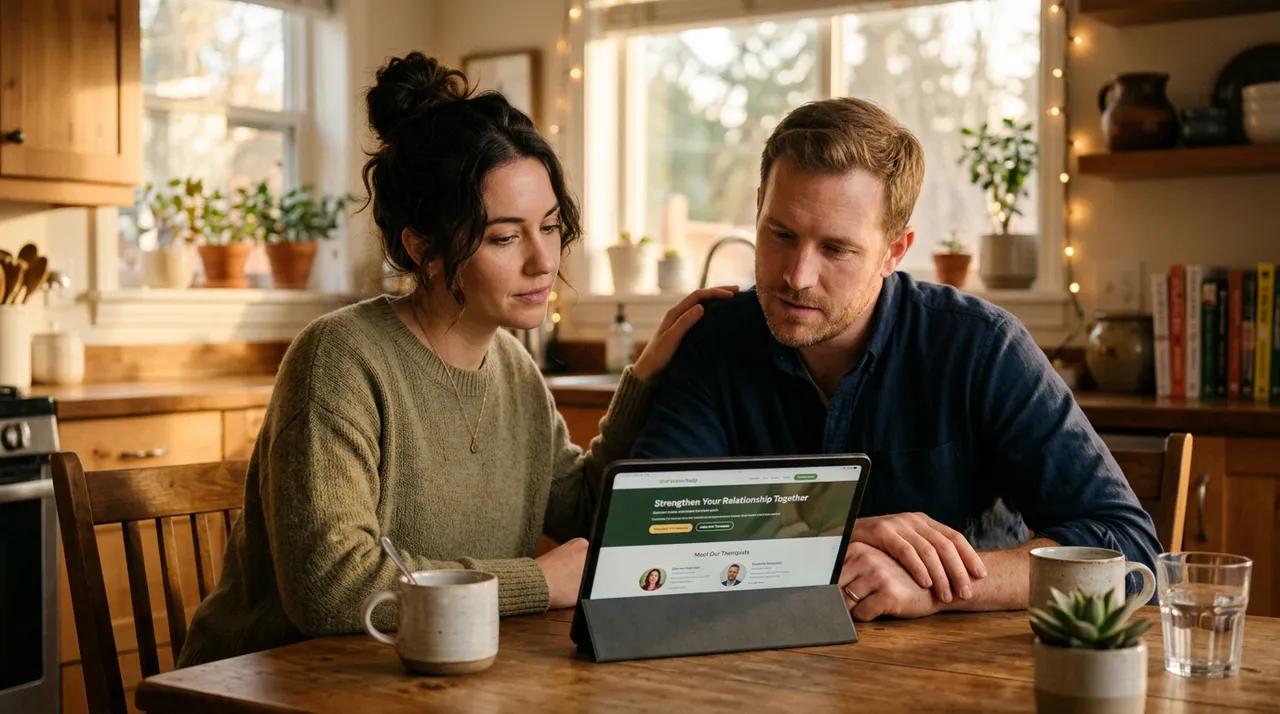
Convenience should never be the only deciding factor, but it does matter. A platform that makes booking simple, protects your privacy, and offers flexible scheduling removes common barriers to getting support. For busy couples, that practical ease can be the difference between saying "we should do this" and actually starting.
Look for clarity around the practitioner's experience, approach, availability, and session format. Some couples want a therapist-led process with deeper emotional exploration. Others are looking for more solution-focused support around communication and relationship habits. Neither is automatically better. It depends on what you need.
This is where a digital care platform can be genuinely helpful. Instead of forcing couples to piece everything together themselves, services such as SympathiQ make it easier to find support that fits your goals, schedule, and comfort level in one secure place.
Relationship progress is not always dramatic. Sometimes it looks like a pause before reacting. A gentler tone during a difficult conversation. Less score-keeping. More clarity about what each of you is actually asking for. Sometimes it looks like recognising that the relationship can heal. Sometimes it looks like realising, with care and honesty, that it may not continue in the same form.
That may sound sobering, but it is also empowering. Good counselling is not about forcing a particular outcome. It is about helping both people communicate more truthfully, understand the relationship more clearly, and make healthier decisions from that place.
If your relationship has been carrying the same tension for months, or if the distance between you feels harder to ignore, waiting for the perfect time may only deepen the gap. Support does not need to be dramatic to be meaningful. Sometimes the first step is simply choosing a time, opening a laptop, and giving the conversation a better chance than it has had before.

Your email address will not be published. Required fields are marked *
The core problem with generic online visibility (a personal website with no search authority, a Google Business listing competing with hundreds of others) is that it's hard for a prospective client to tell who's actually qualified before they book. A directory built around verification solves a different problem than a personal website does — it puts you in front of someone who's already decided they want a verified specialist, not just a search result.
On SympathiQ specifically, every specialist is checked against a real UK professional body — BACP, HCPC, or the relevant equivalent for your specialism — before the profile goes live. That's the actual differentiator worth leading with in your own marketing too: not "I'm on a directory," but "I'm verified."
A few things make a real difference regardless of which directory or platform you're using:
Use the phrase a client would actually type, not a generic job title. "Online CBT therapist in Manchester" gets found by someone searching for exactly that. "Experienced counsellor" doesn't tell a search engine — or a browsing client — anything specific.
Be specific about your niche, rather than listing every modality you're trained in. A profile that clearly says "I work with anxiety and burnout in working professionals" is easier for the right client to recognise themselves in than a profile listing ten specialisms generically.
Write your bio like you're talking to one person, not a marketing audience. A short, honest explanation of why you do this work tends to land better than polished credentials-only copy — clients are choosing a person to be vulnerable with, not hiring a service.
Be upfront about pricing and format. Whether you charge per session or offer packages, whether sessions are video or phone — ambiguity here creates hesitation. Clarity doesn't just help clients decide faster, it filters for people who are actually a good fit for how you work.
Most therapists don't ask for reviews because it feels awkward in a clinical relationship — understandably. But a genuine testimonial from someone who's actually experienced real change is one of the strongest trust signals a prospective client can see before booking. If you're not currently asking, even occasionally, that's a real gap worth closing — timing it well (after a client has had enough sessions to notice a real difference, and being clear it's entirely optional) matters more than asking often.
If you're weighing whether a directory listing is worth the time: it's worth it if your current visibility is mostly word-of-mouth and you have capacity for more clients than that's currently bringing in. It's less urgent if you're already at capacity, in which case the more useful investment is probably in retention and referral systems rather than new-client acquisition.
Do I need to be independently verified to list, or does the platform handle that? On SympathiQ, verification is handled as part of onboarding — you'll be asked for your professional body registration details before your profile goes live, not left to self-declare.
Will a directory listing replace my existing referral network? No, and it shouldn't try to. It's an additional channel for clients who start their search online rather than through a personal recommendation — the two work alongside each other, not instead of each other.
How long does it typically take to start getting enquiries after listing? This varies by specialism, location, and how complete your profile is — a sparse profile with no bio or niche tags will take longer to convert than a specific, well-written one. (Note: don't put a specific timeframe here unless you have real data to back it — the original article's "24 hours to go live" type claims should only be kept if actually true.)