Logo
  • Home
  • Find Specialists
  • Partnerships
    dropdown arrow
      Training CentresUniversities & AcademiaProfessional BodiesBecome a Partner
  • For Specialists
    dropdown arrow
      Therapist & CounsellorFitness & Personal TrainerNutritionist & DietitianLife & Performance CoachBurnout & Stress CoachView all specialist types →
  • Pricing

For Specialists

  • Therapist & Counsellor
  • Fitness & Personal Trainer
  • Nutritionist & Dietitian
  • Life & Performance Coach
  • Burnout & Stress Coach
  • View all specialist types

Partnerships

  • Training Centres
  • Universities & Academia
  • Professional Bodies
  • Become a Partner
Logo
  • Home
  • Find Specialists
  • Partnerships
    dropdown arrow
      Training CentresUniversities & AcademiaProfessional BodiesBecome a Partner
  • For Specialists
    dropdown arrow
      Therapist & CounsellorFitness & Personal TrainerNutritionist & DietitianLife & Performance CoachBurnout & Stress CoachView all specialist types →
  • Pricing

For Specialists

  • Therapist & Counsellor
  • Fitness & Personal Trainer
  • Nutritionist & Dietitian
  • Life & Performance Coach
  • Burnout & Stress Coach
  • View all specialist types

Partnerships

  • Training Centres
  • Universities & Academia
  • Professional Bodies
  • Become a Partner

Subscribe to Our Newsletter

To get the latest tips and news to support your well-being journey!

SympathyiQ logo

Subscribe to our newsletter to get the latest tips and news to support your well-being journey!

Platform

HomeFind SpecialistsPricingNews

Specialists

Join as SpecialistTherapistsFitness TrainersLife Coaches

Company

About usTrust & SafetyWeb AccessibilityTerms & ConditionsPrivacy PolicyContact Us

© 2026 SympathiQ, All Rights Reserved.

ProtectedEU GDPR Compliant
CertifiedMindful Employer
RegisteredICO — Information Commissioner's Office
Powered byStripe
HomeSearch

Showing 1–10 of 142 results

Default Sorting
    Beyond the screens: why loneliness makes us sick and how real connection can save us
    13.08.2026

    Beyond the screens: why loneliness makes us sick and how real connection can save us

    Each of us has wondered, much like you have, how it is possible that, despite being the generation with more communication tools than any other in history, night can still arrive with an emptiness in our chest that keeps us from falling asleep. We have hundreds of virtual friends, connected through smartphones and receive dozens of daily notifications about their lives. And yet, behind this seemingly perfect facade, many of us are fighting an invisible battle: we feel profoundly, painfully alone. And when isolation continues for too long, both the mind and the body begin to suffer in very real ways. Loneliness can gradually transform from a passing feeling of sadness into a genuine mental health crisis.

    How Loneliness Affects Mental and Physical Health?

    I could fill entire pages describing the psychological and mental changes that can occur when you experience prolonged loneliness: how it can contribute to anxiety, hypervigilance, panic attacks, clinical depression, sleep disturbances and exhaustion, emotional burnout, declining self-esteem, cognitive distortions, and addictive or compulsive coping behaviors. I could also explain the mechanisms that can lead us there. Our mental state influences the hormonal and physiological processes taking place in our bodies, and over time, this can begin to affect our physical health, little by little. So instead, I want to tell you something even more fascinating: prolonged loneliness may influence the way our bodies function at a biological level, including through epigenetic mechanisms, and may contribute to physical illness.

    The changes within our cells: how stress can rewrite the way our genes work  and how we can change it

    You may think that anxiety or loneliness are simply mental states, things that happen exclusively inside our heads. Modern science tells us something much deeper: prolonged stress can reach all the way into our cells and influence the way our genes are expressed. This field is known as epigenetics.

    Imagine that your DNA is like an enormous book filled with instructions for how your body functions. Somewhere in that book are instructions for calm, fear, immunity, energy and countless other processes. When you live in isolation or in a state of constant alert for a prolonged period, your body can begin to alter which of these genetic instructions are more readily expressed and which are suppressed. It is almost as though the pages containing the instructions for calm and safety become harder to access, while the pages associated with fear, stress hormones and heightened vigilance remain wide open.

    That is one reason why, after a long period of loneliness or chronic stress, you may feel as though your internal “fear thermostat” has become completely dysregulated. Small things can trigger disproportionately intense reactions, sometimes resembling a panic response. Your body may have become biologically conditioned to perceive danger almost everywhere. But these changes are not necessarily permanent. They can develop in response to a stressful or threatening environment and our biology also has the capacity to adapt when the environment changes.

    Research in neuroscience suggests that psychotherapy and authentic human connection can influence the biological systems involved in stress regulation. When you feel safe with another person, when you feel seen, heard, and understood, your nervous system can gradually begin to move out of a state of chronic threat.

    The therapeutic relationship can help reopen, little by little, the pathways toward calm and safety within your biology. Therapy does not simply change thoughts. It can also help change the way your body responds to life. And so, there is a powerful antidote that does not come in the form of a pill.

    Authentic human connection can be deeply therapeutic.


    When does silence become too loud?

    Woman sitting alone in a busy café while people around her look at their phones

    You know that moment, usually in the evening, when the house becomes quiet and your thoughts suddenly begin racing in every direction? That is not necessarily just boredom. It can be your body entering a state of heightened alertness.

    From an evolutionary perspective, prolonged social isolation has often been interpreted by the brain as a potential threat. In our distant past, being separated from the group could have meant being left without protection or resources. Human beings evolved as deeply social creatures and our nervous systems remain highly sensitive to the presence (or absence) of connection.

    When you feel isolated, your stress-response system can become more active, involving hormones such as cortisol and adrenaline and keeping you more vigilant. If this state continues for months or years, the wear and tear can be profound.

    Constant alertness can gradually turn into the persistent anxiety that tightens your chest, panic attacks, or depressive episodes in which even the simplest things feel exhausting. 

    Loneliness can drain the body while keeping the mind trapped in a vicious cycle: the more isolated we feel, the more threatened we become; the more threatened we become, the harder it can be to reach out and reconnect.


    The trap of the virtual world

    You might say to me: “But I talk to people every day. I chat with them, leave comments, see what everyone else is doing!” I understand completely. But our biological brains are not satisfied by a screen alone. We need something much deeper: we need to experience the presence of another human being.

    A text message cannot fully replace the warmth of a voice, the way someone's eyes light up when they listen to you, or that quiet sigh of relief you experience when you realize that someone truly understands you without judging you. Social media can give us the appearance of connection while leaving us, in reality, emotionally hungry. We can be surrounded by digital interactions and still feel profoundly alone.


    Why real connection can be the “medicine” we need

    Even if relationships are what hurt you, healing will rarely come through isolation. No self-help book read alone in a room can fully replace the transformative experience of a genuine human connection, accompanied by another perspective on the reality you are living. We need another human being to help us feel safe again.

    This is one of the ways an authentic relationship can support healing within a therapeutic space. A therapist is not simply a friend who pats you on the shoulder and tells you to keep going.

    A therapist is a trained professional, equipped to explore the underlying causes of your difficulties and to use appropriate therapeutic approaches that take your unique personality, history, needs, and circumstances into account.

    The goal is not simply to identify the problem, but to help you understand it, work through it, and find a way forward.

    But before being a professional, a therapist is also a human being, a person capable of meeting you with empathy, presence and genuine understanding. And that makes possible one of the most sophisticated things human beings can experience: an authentic connection between two people. Something no social media platform can truly replicate. And something even artificial intelligence cannot replace: the lived experience of being genuinely present with another human being.

    A Human Connection Can Help Us:

    Man putting his phone aside to have a face-to-face conversation

    • Regulate together

    Our nervous systems are deeply influenced by the people around us. When you are with someone who is calm, present, and genuinely attentive, your body can receive the signal that it is finally safe enough to lower its guard. Your heart rate may slow, your breathing may deepen, and your body can gradually move out of a state of constant vigilance.

    • Rewrite painful stories

    Loneliness can make us believe that something is fundamentally wrong with us. When we finally experience genuine human connection, our deepest fears can begin to lose their intensity. They become more manageable, easier to hold, and less powerful. We begin to discover that the story we have been telling ourselves about who we are may not be the whole truth.

    • Learn to breathe again

    Connection can help bring us out of the endless loop of our own thoughts.

    It can help us step away from catastrophic scenarios, interrupt the mental noise and return to the present moment.

    A bridge directly from your safe space

    Perhaps one of the most beautiful possibilities of the world we live in today is that human connection no longer has to depend on physical distance. Online therapy is proof that the screens that so often isolate us can also become bridges toward support and healing. It all depends on how we choose to use them. You do not have to fight through traffic or walk into an unfamiliar office. You can sit comfortably on your own sofa, in the space where you feel safe and allow yourself to enter a meaningful therapeutic connection. On the other side of the screen, there is not only a trained professional ready to accompany you. There is also an entire team working to make that space as safe, supportive and trustworthy for you as the sofa you are sitting on. Emotional presence can travel beyond the glass of a screen.

    You were never meant to carry the weight of the world entirely on your own. Asking for help and seeking connection is not a weakness. It is human. It is normal. It may be one of the most natural things we can do and it can be the first step back toward the life you remember, the life you might simply call HOME.

    Connection means together. And togetherness is where loneliness begins to end.

    Burnout vs. Exhaustion: Why confusing the two can sabotage your recovery

    “I’m completely exhausted.” It is a phrase we hear more and more often these days. We live in an era of extreme productivity, where tiredness has become second nature. Yet when this state persists, many of us make a critical mistake in self-assessment: we confuse physical exhaustion with burnout. Although they may look similar on the surface, psychologically they are two distinct states. And if you apply the wrong solution, you risk deepening your distress even further.

    Here is why the difference matters  and what you need to do in each situation.

    1.Exhaustion

    The battery is at 0%, but you still want to keep going. Exhaustion, in this context, is insufficient or completely depleted energy. It can occur when you have worked intensely, managed a demanding project, lost sleep, or gone through a period of acute stress.

    How does it feel?

    Your body feels heavy, your mind seems foggy, but your underlying motivation remains intact. You still enjoy what you do, you believe in your goals, but you simply no longer have the biological fuel to continue.

    The defining sign

    Hope. An exhausted person knows that if they could sleep for an entire weekend or take a week-long vacation where they could truly disconnect, they would return to work refreshed and with renewed energy.

    The solution

    Physical rest, quality sleep, proper nutrition, and complete disconnection for several days. Recovery is direct.

    2.Burnout

    The engine has not only burned out; you no longer believe in the destination. According to the World Health Organization, burnout is not simply heightened tiredness, but a complex occupational syndrome defined by three dimensions: extreme exhaustion, cynicism (detachment that can progress to apathy toward the job), and a sense of inefficacy (the feeling that nothing you do matters anymore).

    How does it feel?

    Burnout is a qualitative and existential crisis. Even if you sleep ten hours a night or take an extended exotic vacation, you may return feeling just as empty inside. A profound apathy can emerge.

    The defining sign

    Cynicism. Thoughts such as these begin to appear: “Why should I keep doing this? No one cares anyway. Everything is pointless.” You lose your connection with your values and with the meaning of your work.

    The solution

    Passive rest does not work here. Burnout requires reassessing and restructuring certain habits: learning to set firm boundaries, reassessing your personal values, and separating your identity as a human being from your professional performance.

    Why does it matter not to confuse the two?

    Man sitting alone at home feeling stressed and overwhelmed

    If you are experiencing burnout and treat it as simple exhaustion, you may return from vacation straight into the same pattern of over-responsibility that has become toxic for you. When you see the exhaustion return after only two days of work, you may experience a profound sense of personal failure and the false belief may emerge that the problem is you.

    Exhaustion can be restored through rest. Burnout requires redefining the relationship you have with yourself, with yourself in relation to others, and with your work. As specialists, we understand that people who reach burnout often also carry a history of triggers rooted in past trauma or difficult experiences that can contribute to this pattern.

    If vacations no longer work and you have entered the territory of cynicism, your body may be trying to tell you that it is time for a deeper change. You do not have to go through this alone. Psychotherapy, even online, directly from the comfort of your own space can provide a safe environment where we can begin rebuilding these boundaries, piece by piece.

    The hidden cost of permanent availability: digital anxiety in modern life

    Wow! The technological power condensed into the palm of each of our hands has set us free! We can work from anywhere, solve problems regardless of where we are and remain just one click away from clients, colleagues, or friends. All these conveniences, extremely valuable to society as a whole come with an invisible, but very high cost to each individual’s mental health: digital anxiety.

    Driven by our desire for efficiency and competitiveness, and “helped” by our devices, we have become permanently available. And the price we pay for this “luxury” is an overworked nervous system, locked in a continuous state of alert.

    What is digital anxiety, really?

    Digital anxiety is not simply tiredness caused by spending too much time on your phone. It is a state of hypervigilance and overwhelm triggered directly by the dynamics of our online interactions. It can manifest through several subtle but highly harmful behaviors:

    Background Vigilance (Notification Micro-Stress)

    Even when your phone is lying face down, part of your brain remains on alert, waiting for the next email, message, or piece of feedback. Every sound or vibration can trigger a micro-release of cortisol, the stress hormone.

    Fear of Being Disconnected (Nomophobia and FOMO)

    The acute feeling of vulnerability or isolation that appears when you do not have access to the internet or when your battery drops below 10%. You feel that if you are not connected, you are missing something vital or failing in your responsibilities.

    Artificial Urgency

    The internal pressure to respond instantly to every message or email, even outside working hours, turning your free time into an extension of your job.

    Why can’t our minds process permanent availability?

    From a neurobiological perspective, the human brain was not designed to remain connected 24/7 to problems that never end. In the past, a workday ended when you left the factory or office, and with it ended the amount of work and problems assigned to that day. Today, the office has moved into our pockets, work is permanent and new problems will obviously never stop appearing.

    When you are always available, your nervous system never fully relaxes. The transition from a state of alertness (the sympathetic nervous system) to rest and digestion (the parasympathetic nervous system) becomes increasingly difficult. Decision fatigue appears when the uninterrupted flow of information and choices exhausts the cognitive resources of the prefrontal cortex. Sleep can also suffer because screen light and digital rumination before bedtime can interfere with melatonin production, leaving you waking up tired from the very first hour of the morning.


    How to regain control: the first steps toward digital hygiene

    Healing digital anxiety does not mean deleting your accounts or moving to the forest. It means learning to establish firm boundaries between yourself and technology while protecting your mental space. 

    Here is what you could do:

    • Set a “digital stretching” hour. Turn off all work-related notifications after a certain hour in the evening (for example, 7:00 p.m.). The world will not stop existing if you respond the next morning.

    • Create technology-free zones. The bedroom and the family dining table should be sacred spaces where phones are not allowed.

    • Replace the automatic reaction with a deliberate pause. When you receive a notification, take a deep breath for a second before reaching for your phone. Ask yourself first: “Is this really an emergency, or is it simply a habit?”


    Being unavailable from time to time is not an act of selfishness, professional indifference, or lack of competitiveness. It is a genuine sign of respect for your own mental health. And do not forget: your mental health is what allows you to remain empathetic, professionally focused and, above all, competitive!

    If you feel that your phone, beyond being a work tool, has become a constant source of agitation in your chest, remember that help is only one click away. In online therapy, we use the screen not to create more noise, but to rebuild a safe space of quiet, where you can learn how to disconnect from the network in order to reconnect with yourself.

    Written by: Ghiocel Scutaru, Psychotherapist, UK, Manchester (See Professional Profile)

    Read more

    The Men Who Are Coping
    10.08.2026

    The Men Who Are Coping

    From the outside, he's doing well.

    Good career. Busy life. Plenty of responsibility.

    People rely on him.

    He's the one who solves problems, takes responsibility and stays calm when things go wrong.

    The person who gets things done.

    Ask him how he is and he'll probably tell you he's fine.

    Just busy.

    Lots going on.

    You know what it's like.

    And he probably does.

    Because there always seems to be something demanding his attention.

    Work.

    Family.

    Finances.

    Deadlines.

    Decisions.

    Expectations.

    None of it feels particularly unusual. In many ways, it simply feels like adulthood.

    The trouble is that sometimes we get so used to carrying pressure that we stop noticing we're carrying it at all.

    What starts as a busy period quietly becomes a way of life.

    The inability to switch off becomes normal.

    Feeling distracted becomes normal.

    Being permanently tired becomes normal.

    Feeling responsible for everything and everyone becomes normal.

    The problem is that normal and healthy aren't always the same thing.

    Many men don't think of themselves as struggling.

    They're still getting up.

    Still working.

    Still showing up.

    Still doing what needs to be done.

    By all visible measures, they're coping.

    Which is why stress, burnout and emotional exhaustion can go unnoticed for a long time.

    Not because they're weak.

    Quite the opposite.

    Because they're capable.

    Because they're dependable.

    Because they've spent years developing the ability to carry on.

    Some men become so good at coping that nobody notices how much effort it takes.

    Including them.

    Their partner might notice they're more irritable than they used to be.

    Less patient.

    Less present.

    More distracted.

    Friends may realise they never seem to switch off.

    Colleagues may see someone carrying more than their fair share.

    But if you ask the man himself, he may struggle to identify a problem.

    Nothing terrible has happened.

    There has been no crisis.

    No dramatic event.

    No obvious reason why he should be finding life harder than he used to.

    And yet something feels different.

    The satisfaction isn't there.

    The energy isn't there.

    The enjoyment isn't there.

    Everything feels slightly heavier.

    Slightly harder.

    Slightly more effort.

    Counselling may never have crossed his mind.

    Or perhaps it has, briefly, before being dismissed.

    After all, he isn't falling apart.

    He's coping.

    At least, that's what he's always told himself.

    And maybe he's right.

    Maybe he is coping.

    But that isn't always the most useful question.

    Because coping can mean a lot of things.

    Sometimes it means managing well.

    Sometimes it means surviving on determination, habit and momentum.

    Sometimes it means carrying more than is sustainable.

    Have You Ever Felt Like This?

    Tired man working on a laptop late at night and struggling to switch off from work.

    • You struggle to switch off, even when work is finished.

    • You feel tired more often than rested.

    • Small frustrations affect you more than they used to.

    • You find yourself feeling irritable, impatient or withdrawn.

    • You spend most of your time dealing with problems rather than enjoying life.

    • You feel responsible for everyone else's needs while ignoring your own.

    • You tell people you're "fine" automatically.

    • You've been waiting for life to calm down for years.

    • You can't remember the last time you felt genuinely relaxed.

    • You feel as though you're carrying a great deal but talking about very little.

    If several of those feel familiar, you're not alone.

    Many men seek support not because they have reached breaking point, but because they are beginning to wonder whether the effort required to keep everything going has become too high.

    Maybe the question isn't whether you're coping. Maybe it's whether coping has become your full-time job.

    The Men Who Are Coping

    Man feeling distracted while his partner tries to talk to him at home.

    From the outside, he's doing well.

    He has a good career, a busy life and plenty of responsibility. People rely on him. He's the one who solves problems, takes responsibility and stays calm when things go wrong. The person who gets things done.

    Ask him how he is and he'll probably tell you he's fine.

    Just busy.

    Lots going on.

    You know what it's like.

    And he probably does.

    Because there always seems to be something demanding his attention. Work. Family. Finances. Deadlines. Decisions. Expectations. None of it feels particularly unusual. In many ways, it simply feels like adulthood.

    The trouble is that sometimes we get so used to carrying pressure that we stop noticing we're carrying it at all.

    What starts as a busy period quietly becomes a way of life. The inability to switch off becomes normal. Feeling distracted becomes normal. Being permanently tired becomes normal. Feeling responsible for everything and everyone becomes normal.

    The problem is that normal and healthy aren't always the same thing.

    Many men don't think of themselves as struggling. They're still getting up, still working, still showing up and still doing what needs to be done. By all visible measures, they're coping.

    Which is why stress, burnout and emotional exhaustion can go unnoticed for a long time.

    Not because they're weak.

    Quite the opposite.

    Because they're capable. Because they're dependable. Because they've spent years developing the ability to carry on.

    Some men become so good at coping that nobody notices how much effort it takes.

    Including them.

    Their partner might notice they're more irritable than they used to be. Less patient. Less present. More distracted.

    Friends may realise they never seem to switch off. Colleagues may see someone carrying more than their fair share.

    But if you ask the man himself, he may struggle to identify a problem.

    Nothing terrible has happened. There has been no crisis. No dramatic event. No obvious reason why he should be finding life harder than he used to.

    And yet something feels different.

    The satisfaction isn't there.

    The energy isn't there.

    The enjoyment isn't there.

    Everything feels slightly heavier, slightly harder, slightly more effort.

    Counselling may never have crossed his mind. Or perhaps it has, briefly, before being dismissed.

    After all, he isn't falling apart.

    He's coping.

    At least, that's what he's always told himself.

    And maybe he's right.

    Maybe he is coping.

    But that isn't always the most useful question.

    Because coping can mean a lot of things.

    Sometimes it means managing well.

    Sometimes it means surviving on determination, habit and momentum.

    Sometimes it means carrying more than is sustainable.

    Maybe the question isn't whether you're coping. Maybe it's whether coping has become your full-time job.

    Written by: Stuart Walker BSc (Hons), Dip.Couns, MBACP. Integrative Counsellor & Psychotherapist. Me In Time Counselling & Psychotherapy. MSc in Psychotherapy and Counselling at Bath Spa University

    Website: Me In Time Counselling & Psychotherapy


    Read more
    How to Find the Right Career Coach for Your Goals
    11.08.2026

    How to Find the Right Career Coach for Your Goals

    Choosing a career coach is an important decision. Whether you're looking for a new job, considering a career change, preparing for a promotion, or simply feeling uncertain about your next professional step, the right coach can provide guidance, support, and accountability throughout the process.

    However, not every coach will be the right fit for your needs. If you're wondering how to find a career coach or asking yourself, "How do I find a career coach who understands my goals?", this guide will help you make an informed decision. We'll explore where to find a career coach, what qualities to look for, and how to choose someone who can support your professional development.


    How to Find a Career Coach

    The first step is understanding exactly what you hope to achieve. Different coaches specialise in different areas, so being clear about your goals will make it much easier to find someone with the right experience.

    Consider asking yourself:

    • Am I looking for a new job?

    • Do I want to change careers?

    • Am I preparing for a promotion?

    • Do I need help improving my confidence at work?

    • Would I like support with leadership or communication skills?

    Once you've identified your priorities, you can begin researching coaches whose experience aligns with your needs. A good process usually includes:

    1. Defining your career goals.

    2. Researching qualified career coaches.

    3. Reading reviews and testimonials.

    4. Comparing coaching approaches.

    5. Booking an introductory consultation.

    6. Choosing someone you feel comfortable working with.

    Taking time to compare different professionals can help you find a coach who not only has relevant expertise but also communicates in a way that feels supportive and motivating.


    Where to Find a Career Coach

    Person comparing career coach profiles online while taking notes to choose the right career coach.

    There are several reliable places to begin your search. You might consider:

    • Online coaching platforms.

    • Professional coaching directories.

    • Recommendations from colleagues or friends.

    • Professional networking websites such as LinkedIn.

    • Organisations that specialise in wellbeing and career support, such as SympathiQ.

    Looking beyond your local area can also be helpful. Online career coaching allows you to work with experienced professionals regardless of where you live, giving you access to a much wider range of expertise and coaching styles.


    How to Choose a Career Coach

    While certifications and professional experience are important, they're only part of the picture. A successful coaching relationship also depends on trust, communication, and whether the coach's approach matches your needs and personality.

    Start by looking at the coach's background. Have they supported clients with goals similar to yours? For example, someone looking to move into a leadership position may benefit from a coach with executive coaching experience, while someone changing careers might prefer a coach who specialises in career transitions.

    It's also worth exploring how the coach works. Some coaches focus on structured action plans and measurable goals, while others take a more reflective approach, helping clients gain clarity before making decisions. Neither style is inherently better, but one may suit you more than the other.

    Before committing, check whether the coach offers an introductory consultation. This gives you an opportunity to ask questions, understand their coaching process, and decide whether you feel comfortable working together.

    A good coach should leave you feeling listened to, understood, and optimistic about the work you'll do together, rather than pressured into booking more sessions.


    Questions to Ask Before Hiring a Career Coach

    Before deciding to work with a coach, it can be helpful to ask a few questions.

    For example:

    • What experience do you have in career coaching?

    • Have you worked with clients who have goals similar to mine?

    • What does your coaching process involve?

    • How do you measure progress?

    • How often do clients usually have sessions?

    • What happens if my goals change during coaching?

    The answers can help you understand whether the coach's approach aligns with what you're looking for.


    Common Mistakes When Choosing a Career Coach

    Choosing a coach is an investment in your professional development, so it's worth avoiding a few common mistakes. These include:

    • Choosing based only on price.

    • Expecting immediate results.

    • Not checking the coach's background or experience.

    • Selecting a coach without speaking to them first.

    • Assuming every coach offers the same type of support.

    Taking time to research your options can help you find someone who genuinely meets your needs.


    Signs You've Found the Right Career Coach

    Finding the right career coach isn't just about qualifications or years of experience. One of the best indicators is how you feel during and after your sessions. A strong coaching relationship should leave you feeling supported, motivated, and better equipped to make decisions about your career. While every coach has a different style, there are several signs that you've found someone who is a good fit for your goals.

    Career coach and client walking together outdoors while discussing professional goals.

    You may have found the right career coach if:

    • You feel comfortable speaking openly. You can discuss your challenges, ambitions, and concerns without worrying about being judged.

    • They listen more than they talk. Rather than giving immediate advice, they ask thoughtful questions that help you reflect and find your own solutions.

    • Your goals become clearer. After each session, you have a better understanding of what you want and the practical steps needed to get there.

    • They challenge you in a supportive way. A good coach encourages you to step outside your comfort zone while respecting your pace and individual circumstances.

    • You leave sessions feeling motivated. Even when conversations cover difficult topics, you finish with greater confidence and a clearer sense of direction.

    • They tailor their approach to you. Instead of following a standard programme, they adapt sessions to your goals, strengths, and changing needs.

    • You notice progress over time. Career coaching is rarely about dramatic overnight changes. Instead, you begin to make more confident decisions, communicate more effectively, and feel increasingly capable of managing your career.

    Who Can Benefit Most From Career Coaching?

    Career coaching isn't just for people who are unhappy in their jobs. It can benefit anyone who wants to make informed career decisions, overcome professional challenges, or continue growing in their chosen field. Whether you're starting out, changing direction, or aiming for your next promotion, career coaching provides a structured space to reflect, plan, and take action. Some of the people who may benefit most from career coaching include:

    Students and Recent Graduates

    Starting your career can feel overwhelming, especially when you're unsure which direction to take. A career coach can help you identify your strengths, explore different career paths, improve your CV, and prepare for interviews with greater confidence.

    Professionals Considering a Career Change

    Changing careers often involves uncertainty and difficult decisions. A career coach can help you assess your transferable skills, explore new opportunities, and create a realistic plan for moving into a different industry or role.

    People Looking for a Promotion

    If you're ready to progress within your current organisation, coaching can help you develop leadership skills, improve workplace communication, and build the confidence needed to take on greater responsibility.

    Individuals Returning to Work

    Returning to work after parental leave, caring responsibilities, illness, or another career break can feel daunting. Career coaching can support you in rebuilding confidence, updating your professional goals, and preparing for your next opportunity.

    Managers and Business Leaders

    Leadership roles often bring new challenges, from managing teams to making strategic decisions. Career coaching provides a confidential space to develop leadership skills, improve decision-making, and navigate workplace challenges more effectively.

    People Feeling Stuck or Uncertain

    Sometimes there isn't a clear problem to solve, but work simply no longer feels fulfilling. If you're feeling unmotivated, uncertain about your future, or unsure what your next step should be, career coaching can help you gain clarity and identify new possibilities.


    Career Coaching Online vs In-Person Coaching

    When choosing a career coach, one of the first decisions you'll make is whether to work together online or in person. Both approaches can be effective, and the right option often depends on your preferences, schedule, and the type of support you're looking for.

    • Online career coaching has become increasingly popular because it offers greater flexibility. Sessions can take place from home, during a lunch break, or while travelling, making it easier to fit coaching around work and family commitments. It also allows you to choose from a much wider range of coaches, rather than being limited to those in your local area.

    • In-person career coaching, on the other hand, may appeal to people who prefer meeting face to face. Some clients find it easier to build rapport in the same room, while others simply enjoy having dedicated time away from home or the office to focus on their professional development.

    In terms of outcomes, there is no evidence that one format is inherently better than the other. What tends to matter most is the quality of the coaching relationship, your commitment to the process, and whether the coach's expertise aligns with your goals.

    For many people, online coaching offers several practical advantages:

    • Greater flexibility when scheduling sessions.

    • Access to experienced coaches across the UK rather than just locally.

    • No travel time or commuting costs.

    • Easier to fit around busy work schedules.

    • The comfort and privacy of joining sessions from your own space.

    Career Coaching Isn't Just for Finding a New Job

    Career coaching is often associated with job searching or changing careers, but its value goes much further. You don't need to be unhappy in your current role or actively looking for a new one to benefit from professional support.

    For example, career coaching can be particularly valuable when you're stepping into a leadership position and need to develop new skills, manage greater responsibility, or become more confident in your decision-making. It can also support professionals navigating significant life and career transitions, including returning to work after parental leave, caring responsibilities, illness, or another career break.

    Sometimes, the goal isn't to change jobs at all. You may have a successful career but feel that your work no longer reflects your priorities or gives you the same sense of fulfilment. A career coach can help you explore what matters to you, identify what may be missing, and consider how your current career could become better aligned with your values, strengths, and long-term goals. Ultimately, career coaching isn't only about deciding what job to do next. It can also be about finding ways to grow, lead, adapt, and feel more fulfilled in the career you already have.


    Ready to Take the Next Step in Your Career?

    Whether you're looking for a new role, planning a career change, or aiming to grow professionally, the right support can make all the difference. At SympathiQ, you can connect with experienced online career coaches who will help you clarify your goals, overcome challenges, and build a practical plan for your future. Find the right career coach today and start moving towards the career you want!

    Reviewed by Gemma Bell (Business Mindset Coach)


    Read more
    Private Practice or Marketplace: Which Fits You?
    08.08.2026

    Private Practice or Marketplace: Which Fits You?

    A fully booked diary can look very different depending on how you built it. When weighing private practice or marketplace, the real question is not which route is universally better. It is which setup gives you the time, income, visibility and client experience you need to do your best work.

    For therapists, coaches, dietitians, fitness specialists and personal development professionals, the choice can shape far more than administration. It affects how new clients find you, how much of your week goes into marketing, how you set boundaries, and whether growth feels energising or exhausting.

    Private practice or marketplace: the core difference

    A private practice is a business you build and run under your own name or brand. You choose your systems, define your offers, market your services and manage the full client journey. The rewards can include greater autonomy and a direct relationship with every client. The responsibility is that you carry the operational load too.

    A marketplace brings practitioners together in one trusted digital space where people can search for support, compare specialist profiles and book sessions. The platform may provide scheduling, payments, video consultations, profile visibility and client management tools. In return, it usually takes a fee or commission, or charges for access to its services.

    Neither model removes the need for thoughtful, ethical practice. Both require clear qualifications, appropriate scope of practice, confidentiality and a genuine commitment to client care. The difference lies in where the business infrastructure sits and who is responsible for bringing new people through the door.

    When private practice gives you the right foundations

    Private practice can be deeply rewarding when you have a clear niche, an established referral network or a strong appetite for building a business. You have freedom to shape your work around the people you serve best, whether that means supporting professionals with burnout, helping couples communicate more openly, or creating nutrition coaching programmes with regular accountability.

    You also decide how your brand feels. From your website and onboarding process to your session format and follow-up resources, every touchpoint can reflect your approach. That level of ownership can create a strong sense of purpose and help clients understand exactly what they can expect from you.

    Financially, private practice may offer higher revenue per session because you are not sharing a percentage with a platform. But revenue is not the same as profit or take-home pay. Website costs, booking software, insurance, payment processing, supervision, accounting, advertising and unpaid admin all need a place in your budget. So does the time spent replying to enquiries, chasing forms and filling last-minute gaps.

    Private practice tends to suit you if you are comfortable being both practitioner and business owner. It can be particularly effective when your calendar is already supported by referrals, repeat clients or a recognisable local or online reputation.

    The less visible cost: finding clients consistently

    The challenging part is rarely setting up a profile or choosing a booking tool. It is creating a reliable flow of suitable enquiries without making marketing a second full-time job.

    Some practitioners enjoy writing, networking and creating educational content. Others would rather use that energy in sessions, preparation and professional development. There is no failure in either preference. Knowing which work drains you is useful business information.

    A private practice can also feel quieter in its early stages. A specialist may be excellent at their work and still face unpredictable bookings because potential clients do not yet know they exist or are unsure whether they are the right fit.

    What a marketplace can make easier

    A marketplace is designed to reduce some of that friction. It places your profile in front of people who are already looking for support and gives them a clear route from curiosity to booking. For clients, this can feel less daunting than starting with a blank search bar. They can explore different types of care, compare availability and choose a practitioner whose approach feels right.

    For specialists, that discovery layer can be valuable. Instead of building every system from scratch, you may gain access to practical tools that support virtual sessions, scheduling, payment collection and client communication. A platform such as SympathiQ can also place your work within a wider wellbeing journey, where mental wellbeing, movement, nutrition and personal growth are considered together rather than as separate problems.

    This does not mean a marketplace is a source of effortless bookings. Your profile still needs to be clear, warm and specific. Availability matters, as does your ability to help prospective clients understand what working with you may look like. The platform can create visibility, but trust is built through the quality of your presence and care.

    The trade-off: less control in some areas

    Marketplaces have rules, standards and shared systems. You may have less control over how your services are displayed, what information clients see first or how fees are structured. You may also be one of several professionals in a similar category.

    That competition is not automatically negative. Thoughtful comparison can help clients make informed choices. Still, it means your profile should communicate more than a job title. Be precise about the people you support, the goals you work towards, your session style and any relevant experience.

    Before joining, ask how client relationships are managed, how payments work, what support is offered when issues arise, and whether you can set your own availability and pricing. Review the platform's privacy practices, professional requirements and cancellation policies. These details protect both your business and the people who trust you with sensitive information.

    Choose based on your current season, not an idealised future

    The most useful decision often comes from looking at your present capacity. A practitioner with a full caseload and strong systems may benefit from investing further in their own practice. Someone returning from a career break, moving into online work or seeking a steadier route to new enquiries may value a marketplace's built-in infrastructure.

    You can also use a hybrid approach. Keep your independent practice while joining a marketplace to broaden your reach, test a new speciality or fill selected appointment times. This can give you the security of an established base without placing all your growth expectations on one channel.

    The key is to avoid overextending yourself. If you are promoting your practice on five channels, managing several disconnected tools and responding to messages late at night, more visibility may not be the answer. A simpler system with clear boundaries can support better care and a more sustainable working life.

    Questions to answer before you decide

    Start with the experience you want to create for clients. Do they need easy online booking, flexible evening appointments, a choice of complementary specialists or a highly tailored journey with you from first enquiry onwards? Your answer should guide the model, not follow it.

    Then look honestly at your numbers. Consider the fee you receive per session, the cost of software and marketing, the hours you spend on non-client work and the number of sessions you need each month to feel financially secure. A lower session fee through a marketplace may still be worthwhile if it replaces costly advertising or reduces unpaid admin.

    Finally, consider your energy. Do you feel motivated by developing a distinct brand, or relieved by the idea of shared infrastructure and a ready-made place to be discovered? A model that fits your working style is more likely to last.

    Build a practice that leaves room for care

    Whether you choose independent practice, a marketplace or a blend of both, your systems should make it easier for people to seek support. Clear pricing, straightforward booking, secure communication and realistic availability all reduce uncertainty at a moment when clients may already feel overwhelmed.

    Your business model is not a permanent identity. It is a practical choice that can evolve as your confidence, client base and goals change. Choose the path that lets you show up with presence, protect your boundaries and keep making space for meaningful progress - for your clients and for yourself.

    Read more
    A Practical Guide to Online Specialist Booking
    06.08.2026

    A Practical Guide to Online Specialist Booking

    A packed diary should not force you to put your wellbeing on hold. Whether you are managing burnout, trying to build healthier routines, working through relationship challenges, or looking for focused emotional support, a guide to online specialist booking can make the first step feel clearer. The aim is not simply to find the next available appointment. It is to find support that feels relevant, safe and realistic for your life.

    Online sessions can remove familiar barriers: travel time, limited local options and the pressure of fitting care into a working week. They also give you more choice. That choice is valuable, but it can feel overwhelming when every profile sounds promising. A thoughtful booking process helps you move from scrolling to purposeful action.

    Your guide to online specialist booking

    The right specialist is not always the person with the longest biography or the earliest slot. It is the person whose expertise, approach and practical availability align with what you need right now. Before comparing profiles, give yourself a moment to name the outcome you want.

    Perhaps you want to feel less drained by work, eat in a way that supports your energy, communicate more calmly with your partner, or create a fitness routine you can sustain. You do not need a perfectly worded goal. A simple starting point such as, “I want support with stress that is affecting my sleep,” gives you a useful filter.

    It also helps to consider the type of support you are seeking. A therapist or counsellor may focus on emotional wellbeing, difficult experiences and mental health concerns. A burnout coach may work with boundaries, workload patterns and recovery habits. A dietitian can provide evidence-based nutrition guidance, while a fitness professional may help you build movement habits around your ability and preferences. Personal development support can be especially useful when you want structure, accountability and greater clarity around a life or career goal.

    These areas often overlap. Stress can affect sleep, food choices and motivation; physical health goals can be shaped by confidence and emotional wellbeing. Holistic support recognises those connections without expecting one practitioner to do every job. If your needs span more than one area, you may benefit from beginning with the concern that feels most urgent, then adding other support as your goals become clearer.

    Start with your goals, not a label

    Search terms can be useful, but labels are only a starting point. Two people looking for “stress support” may need very different things. One may want practical strategies for a demanding job. Another may need a confidential space to explore anxiety, grief or persistent low mood.

    When reviewing a specialist, look for the concerns they commonly support, their stated methods and the outcomes they help clients work towards. A well-written profile should help you understand what sessions might involve, rather than relying on vague promises of transformation. Notice whether the language feels respectful and clear. You should be able to tell if their approach is structured, reflective, goal-led, practical or a blend of these.

    Fit is personal. Some people prefer direct guidance and between-session exercises; others need more space to talk and process. Neither preference is better. The best choice depends on what helps you feel heard and able to take the next step.

    Where a specialist offers a brief introductory conversation, use it to explore fit rather than trying to solve everything at once. You might ask how they typically support someone with a goal like yours, what progress could look like, and how they review whether the work is helping. Their answers should be grounded and honest. No responsible professional can guarantee a particular result or a fixed timeframe.

    Check qualifications, scope and trust signals

    Online care still deserves the same care and consideration you would bring to an in-person appointment. Review a specialist’s training, professional memberships or registrations where relevant, and experience in the area you want help with. The exact credentials to look for depend on the service.

    For example, a registered dietitian has a different scope from a general nutrition coach, and a regulated mental health professional has different training from a wellbeing coach. Coaching can be deeply valuable, but it is not a replacement for clinical assessment or treatment when that is what you need. A trustworthy practitioner should be transparent about their role, boundaries and when they would recommend additional or alternative support.

    Privacy matters just as much. Before booking, check how sessions are delivered, how personal information is handled and whether payment and communication take place through a secure system. Choose a private place for your appointment if possible, use headphones when you need them, and think about what would help you speak freely. For some people, that might be a parked car or a quiet room during a lunch break. For others, a session at home after work will feel more comfortable.

    Platforms such as SympathiQ can make this process easier by bringing specialist discovery, booking and virtual care into one place. Even so, your own judgement remains central. Read the details, ask questions and choose the support that feels appropriate for you.

    Book a time you can protect

    Convenience is one of online care’s biggest strengths, but only if the appointment is genuinely workable. Do not automatically choose the first slot that appears. Consider when you are most likely to have privacy, energy and a few minutes afterwards to reflect.

    A session squeezed between two intense meetings may create more pressure than support. If your schedule is unpredictable, look for flexible booking options and decide in advance how you will handle changes. Review cancellation terms before you confirm, particularly if you are booking a package or a recurring session.

    It is also worth being realistic about frequency. Weekly support can suit someone building momentum through a difficult period, while fortnightly or monthly sessions may be more manageable for an established goal or a constrained budget. Consistency usually matters more than choosing an ideal schedule that you cannot maintain.

    Affordability deserves an open look, too. Check the session cost, whether there are package options, and what each option includes. Lower cost does not automatically mean lower quality, and a higher price does not guarantee the right fit. The useful question is whether the service offers enough value, clarity and practical support for your circumstances.

    Prepare for the first session without overthinking it

    You are not expected to arrive with a polished story or a complete plan. A few notes can help if you tend to go blank under pressure: what has been difficult lately, what you hope might change, and any questions you want to ask. That is enough.

    Your first appointment is also an opportunity to understand how the specialist works. You may discuss your background, current routines, goals and any factors that could affect the work. Be honest about what you can realistically commit to. A sustainable plan built around your actual life is more useful than an ambitious one that quickly becomes another source of guilt.

    Pay attention to how you feel during and after the session. Feeling emotional, challenged or thoughtful can be a natural part of meaningful support. But you should still feel respected, listened to and clear about the next step. If you leave consistently confused, dismissed or pressured, that is useful information.

    Give the relationship time, but know when to change

    A strong specialist relationship often takes more than one session to develop. Progress may be gradual, especially when you are changing long-standing habits or working through complex feelings. Agreeing on a goal and checking in on it regularly can help you notice changes that are easy to overlook day to day.

    At the same time, you are allowed to change direction. If the approach does not suit you, your needs have shifted, or practical arrangements no longer work, it is reasonable to discuss it or book with someone else. Changing specialist is not a failure. It is part of taking an active role in your care.

    For urgent mental health concerns, online coaching or routine wellbeing sessions may not be the right level of support. If you or someone else is in immediate danger in the UK, call 999. For urgent health advice, contact NHS 111. Samaritans are available on 116 123 for anyone who needs someone to listen.

    The most helpful booking is often not the perfect one. It is the considered appointment that gives you protected time, the right kind of expertise and permission to focus on yourself. Choose one small next step, reserve the space in your diary, and let that decision become part of the care you are building.

    Read more
    Life Coach vs Therapist: Which One Do You Need?
    11.08.2026

    Life Coach vs Therapist: Which One Do You Need?

    You're looking for support, but you're not sure what kind. This is one of the most common questions I hear as a psychologist: “Do I need a life coach or a therapist?” Usually, people asking this question are not interested in professional labels. They simply want to feel better, move forward, make a decision, improve their confidence, or understand why they keep finding themselves in the same situations. The challenge is that coaching and therapy can look similar from the outside. Both involve conversations, both involve personal growth, and both can help you create positive change. Yet they serve different purposes.In my experience, choosing between coaching and therapy becomes much easier when you stop focusing on titles and start focusing on what you need right now. This article will explain the difference between a life coach and a therapist, who each approach is best suited for, and how to decide which type of support may help you most.

    What Does a Life Coach Do?

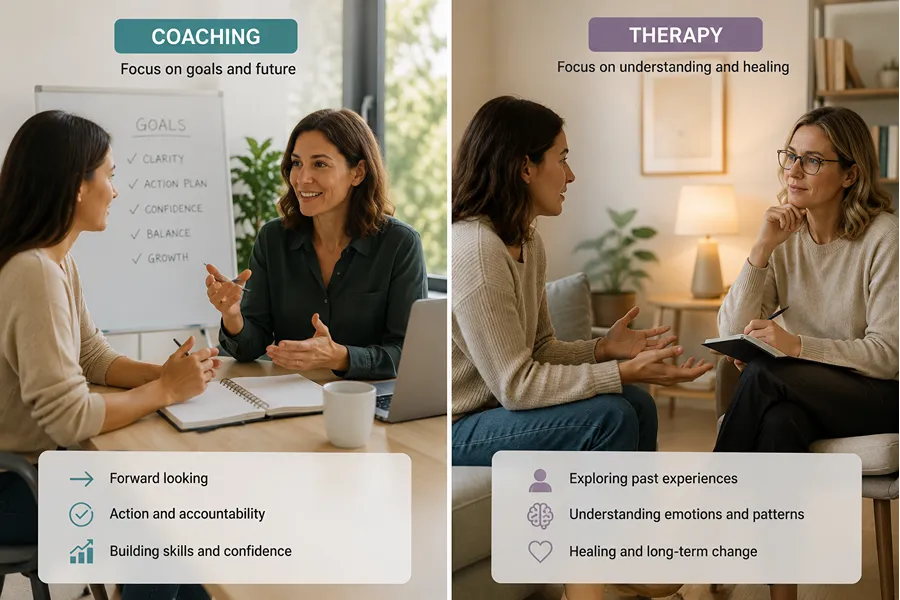
    Think of coaching as a forward-looking conversation. A life coach helps people gain clarity, set goals, build confidence, and take practical action. The focus is not primarily on analysing the past. Instead, it is on creating meaningful change in the future. People often work with a coach when they know something needs to change but are unsure how to make it happen. They may want a career change, greater confidence, stronger leadership skills, better work-life balance, or a clearer sense of direction. On SympathiQ, coaching may include life coaching, executive coaching, and personal development support. You can explore available coaches through the Find a Coach → /find-a-coach page.

    One of the biggest outcomes of coaching is momentum. Clients often move from feeling stuck and uncertain to feeling focused and motivated. A client who feels stuck in their career but is not experiencing depression might benefit more from a coach than a therapist. In this situation, the challenge is not emotional healing. The challenge is creating a plan, exploring options, and moving forward with confidence.

    Coaches typically work with people who are functioning well in daily life and want to move forward rather than people experiencing a crisis. The coaching relationship is often practical, structured, and focused on growth. nother common example comes from the workplace.  Imagine a manager who is performing well but feels overwhelmed by increasing responsibilities. They are not experiencing anxiety that requires therapeutic support, but they struggle with delegation, confidence, and maintaining a healthy work-life balance.

    In this situation, coaching can provide practical tools, accountability, and structured support. Rather than focusing on emotional healing, the work focuses on leadership development, communication skills, resilience, and sustainable performance. This is one reason coaching is becoming increasingly popular within corporate wellbeing programmes, where organisations want to support employee growth before challenges begin affecting performance or wellbeing.

    Comparison between life coaching focused on goals and future action and therapy focused on emotional understanding and healing.

    What Does a Therapist or Counsellor Do?

    Therapy focuses on understanding and working through emotional experiences. While coaching often asks, “Where do you want to go?”, therapy is more likely to ask, “What might be getting in the way?” Many people come to therapy believing they need answers. They want someone to tell them what decision to make, whether a relationship can be saved, how to stop feeling anxious, or how to become more confident.

    Yet what they often discover is that they do not need answers as much as they need space to understand themselves more clearly. Therapy can help people navigate anxiety, relationship difficulties, emotional patterns, low self-esteem, grief, and the impact of past experiences. It is less about finding quick answers and more about understanding yourself in a meaningful and lasting way.

    Counsellors often provide shorter-term support focused on a specific issue. Therapists may work more deeply and over a longer period of time. The distinction is not always strict, but this is a useful general guide. Someone experiencing panic attacks, grief, or the aftermath of a difficult relationship is more likely to benefit from a therapist.

    In my experience as a psychologist, many people discover that the issue they first describe is not the real issue at all. What looks like a confidence problem may actually be years of self-criticism. What looks like a motivation problem may be emotional exhaustion. All therapists on the SympathiQ platform are verified members of professional bodies such as BACP, UKCP, and BPS. You can browse verified therapists on the Find a Therapist /find-a-therapist page.

    Key Differences Between Life Coach vs Therapist

    Life Coach

    Therapist

    Focus

    Future goals and growth

    Past patterns and emotional healing

    Best for

    Feeling stuck, career, confidence

    Anxiety, grief, trauma, relationships

    Typical length

    6-12 sessions

    Ongoing, varies

    Regulated in UK?

    No formal regulation

    Yes - BACP, UKCP, BPS etc.

    On SympathiQ?

    Yes - verified coaches

    Yes - verified therapists


    How to Choose - 3 Questions to Ask Yourself

    If you are still unsure whether you need a life coach or therapist, these three questions can help.


    Question 1: Are you looking to move forward, or work through something?

    If your main goal is growth, direction, confidence, or achieving a specific outcome, coaching may be the right fit. If you feel that emotional experiences from the past are affecting the present, therapy may be more helpful.

    Question 2: Is what you're experiencing affecting your daily functioning?

    Consider your sleep, eating habits, relationships, concentration, and work. If these areas are being significantly affected, I would generally suggest speaking with a therapist first. If not, coaching may be a good starting point.


    Question 3: Have you tried talking about this before and felt you needed something more?

    Many people have supportive friends and family. Yet they still feel stuck in the same cycle. If that sounds familiar, therapy may help you explore what is happening at a deeper level. There is no wrong answer - and it is always possible to switch, or work with both at the same time.

    Can You Work With Both at the Same Time?

    Absolutely. Coaching and therapy are complementary rather than competing. Some people work with a therapist to process emotions, understand patterns, and improve wellbeing, while working with a coach to set goals and stay accountable for change. For example, someone recovering from burnout might explore the emotional reasons behind their exhaustion in therapy while working with a coach to create healthier boundaries and a realistic plan for the future. This approach is becoming increasingly common in corporate wellbeing programmes and among people who want support in multiple areas of life. The important thing is not choosing the “perfect” option. The important thing is choosing the support that feels right for where you are today.

    FAQs

    : Professional speaking with a life coach during a video call while discussing goals and future plans.

    Is a life coach regulated in the UK?

    Life coaching is not a regulated profession in the UK - anyone can call themselves a life coach. This is why using a verified platform like SympathiQ matters: every coach is credentialed and vetted before they can accept clients.

    Do I need a GP referral to see a therapist online?

    No. You can book directly with a private therapist without a GP referral. On SympathiQ, all therapists are verified professionals you can book with immediately - no waiting list, no referral required.

    How much does a life coach cost in the UK?

    Life coaching sessions typically cost £60-£150 per hour with an independent coach. On SympathiQ, you can browse verified coaches, see their rates, and book directly - with no hidden fees.

    What is the difference between a counsellor and a psychotherapist?

    Counsellors typically offer shorter-term support focused on specific issues. Psychotherapists are trained for longer-term, deeper work on underlying emotional patterns. Both are associated with professional bodies such as BACP and UKCP in the UK.

    Can coaching help with confidence?

    Coaching can be highly effective for people who want to build confidence in specific areas of their lives, such as leadership, career development, communication, or decision-making. If confidence difficulties are linked to deeper emotional experiences or long-standing patterns, therapy may also be worth considering.

    Can I switch from coaching to therapy later?

    Absolutely. Many people begin with coaching and later decide they would benefit from therapy, while others start with therapy and move into coaching once they feel ready to focus on future goals. The two approaches can work together at different stages of life.

    How do I know if I need a coach or a therapist?

    A useful starting point is to ask whether you are trying to move towards a goal or work through something that is affecting your emotional wellbeing. If you are still unsure, you do not have to figure it out alone. SympathiQ's assessment /assessment and intelligent matching process are designed to help connect you with the most appropriate professional based on your goals, challenges, and preferences. In many cases, clients arrive unsure whether they need coaching or therapy, and the platform helps guide them towards the type of support that is likely to be most beneficial. The goal is not simply to find a professional, but to find the right professional for your specific situation.


    Final Thoughts

    If there is one thing I have learned from working with people over the years, it is that most of us wait far too long before reaching out for support. We tell ourselves we should be able to handle things alone. We hope the uncertainty will pass, the anxiety will disappear, or the relationship will somehow improve on its own. Sometimes it does. Often, it doesn't.

    Seeking support is not a sign of weakness. It is often the moment people stop struggling in isolation and start moving forward with greater clarity and confidence. Whether you choose coaching, therapy, or a combination of both, the goal is not to become a different person. The goal is to better understand yourself, recognise what you need, and create a life that feels more aligned with who you are.

    The most important step is deciding to get support at all. Whether that's coaching, therapy, or both - there is no wrong starting point. SympathiQ makes it easy to find a verified professional who is right for you.

    Written by: Alona Perederiy, Psychologist, Positive Psychotherapist (WAPP), Graduate Member of the British Psychological Society (MBPsS), Founder Psychologist and Wellbeing Adviser at SympathiQ. With over 10 years of experience supporting clients through life transitions, anxiety, self-esteem challenges, and personal growth.

    Read more
    Best Online Counselling Services Explained
    04.08.2026

    Best Online Counselling Services Explained

    A late-night search for the best online counselling services usually starts the same way - when life already feels heavy, and every option sounds reassuring in exactly the same bland way. If you are trying to find support for stress, burnout, anxiety, relationship strain or emotional overwhelm, the real question is not which platform shouts the loudest. It is which service feels safe, practical and genuinely right for you.

    Online counselling has changed what support can look like. It no longer has to mean travelling across town, rearranging your working day or waiting weeks just to have a first conversation. For many people, the appeal is simple: private support, from home, on a schedule that fits real life. But convenience alone does not make a service good. The best choice is usually the one that balances clinical quality, personal fit, privacy and ease of use without making you work hard to get help.

    What makes the best online counselling services stand out?

    The strongest services tend to do a few things very well. First, they make it easy to understand who you will be speaking to. Credentials matter, but so does clarity. You should be able to see whether a counsellor specialises in anxiety, workplace stress, grief, couples support or another area relevant to your situation. Vague promises about feeling better are not enough when you are trusting someone with sensitive parts of your life.

    Second, good platforms reduce friction. Booking should be straightforward. Session formats should be clear. Prices should not be hidden behind sign-up walls. When a service is genuinely designed around wellbeing, it does not create more stress just to access care.

    Third, the best services recognise that support is personal. One person may want structured, goal-based counselling with clear progress markers. Another may need a softer, reflective space to talk things through. Neither approach is automatically better. What matters is whether the service helps you find the right style of support rather than funnelling everyone into the same model.

    Not all online counselling works in the same way

    This is where many people get stuck. "Online counselling" sounds like one thing, but in practice it can mean very different experiences.

    Some services focus on live video sessions with a consistent practitioner, which often suits people who want continuity and a stronger therapeutic relationship. Others offer text-based messaging, which can feel more approachable at first but may not provide the same depth for complex concerns. There are also platforms that operate more like broad wellbeing marketplaces, where counselling sits alongside coaching, nutrition or burnout support.

    That broader model can be especially helpful if your challenge is not neatly boxed into one category. Someone dealing with chronic stress, poor sleep, low mood and work pressure may not need counselling alone. They may benefit from a more holistic route that supports both emotional wellbeing and the habits around it. That does not replace therapy when therapy is needed, but it reflects how life often works in practice.

    How to compare the best online counselling services

    Start with the issue you actually want help with, not the trendiest platform. If your main concern is anxiety, look for practitioners experienced in that area. If you are navigating relationship conflict, seek out someone who understands relational dynamics. If you feel burnt out rather than clinically unwell, you may benefit from counselling combined with practical support around boundaries, routines and recovery.

    Then look at the care journey. A strong service should help you move from uncertainty to action without guesswork. Can you browse specialists easily? Can you choose between session times that work around your job or family life? Can you switch practitioner if the fit is not right? These small details matter because they affect whether you stay engaged long enough to benefit.

    Pricing deserves careful attention too. Lower cost does not always mean better value, and premium branding does not guarantee better care. Some subscriptions appear affordable until you realise they limit live contact. Other services charge per session, which can be more transparent and flexible. The right structure depends on whether you want ongoing regular support or occasional sessions during a difficult period.

    The questions worth asking before you book

    Before choosing a service, it helps to be honest about what you need right now. Do you want a space to talk, or do you want practical strategies as well? Are you looking for short-term support around a specific challenge, or something more open-ended? Do you feel comfortable on video, or would phone sessions make you more likely to show up consistently?

    It is also worth checking how the platform handles privacy. Counselling only works when you feel secure enough to be open. Clear information about confidentiality, secure systems and data handling should not be buried in fine print. It should be part of the service promise from the outset.

    Finally, consider whether you want a narrow counselling platform or something that supports wider wellbeing. For some people, a single-focus service is ideal. For others, especially those juggling stress across work, health and relationships, having access to complementary forms of support can make progress feel more connected and sustainable.

    Best online counselling services for busy adults

    Busy adults often need more than reassurance. They need support that fits around full calendars, mental load and the simple fact that energy is limited. In that context, the best online counselling services are usually the ones that make consistency realistic.

    Flexible scheduling matters. Evening and lunchtime appointments can be the difference between getting support and putting it off for another month. Easy rescheduling matters too, because life does not become neatly organised just because you have decided to seek help.

    The platform experience matters more than people assume. If logging in is clunky, reminders are unclear or booking feels like admin, it creates another barrier for people already stretched thin. Good digital care should feel calm, intuitive and respectful of your time.

    This is also where holistic platforms can offer real value. A person might begin by seeking counselling for stress, then realise sleep, movement, nutrition or burnout habits are part of the picture. Services that acknowledge this wider context can help people build steadier progress instead of chasing relief in isolated pieces. That joined-up approach is one reason some users are drawn to platforms such as SympathiQ, where emotional wellbeing sits alongside other forms of specialist support.

    When online counselling may not be the right fit

    Online counselling is helpful for many people, but it is not the answer to every situation. If someone is in immediate crisis or needs urgent psychiatric support, a standard online counselling platform may not be enough. The same can apply when internet privacy at home is limited, or when a person strongly prefers in-person connection and finds virtual sessions emotionally flat.

    There is also the simple fact of human fit. A well-designed service can still pair you with a counsellor who is not quite right for you. That does not mean counselling has failed. It usually means another practitioner or approach may suit you better. The best platforms make that easier rather than making you feel awkward for wanting a change.

    Choosing support that feels right, not just available

    When people search for the best online counselling services, they are often searching for relief, clarity and a sense that change is still possible. The most useful service is not necessarily the biggest or cheapest. It is the one that helps you feel understood, gives you practical access to expert support, and meets you where you are without judgement.

    That might mean weekly video sessions with one trusted counsellor. It might mean starting gently with flexible online appointments while you work through stress and burnout. It might mean choosing a platform that sees your wellbeing as connected, not compartmentalised.

    A good first step does not need to be dramatic. It just needs to be honest. If something in your life feels heavy, stuck or harder than it should, choosing support is not a last resort. It is a steady, self-respecting move towards feeling more like yourself again.

    Read more
    How Virtual Couples Therapy Helps Partners
    30.07.2026

    How Virtual Couples Therapy Helps Partners

    You do not usually wake up one morning and decide your relationship needs support. More often, it shows up in smaller ways - the same argument looping every week, the silence after a difficult day, the feeling that you are living alongside each other rather than with each other. That is often where how virtual couples therapy helps becomes most clear: it creates a structured, private space to slow things down and work through what daily life keeps pushing aside.

    For many couples, online support feels less intimidating than sitting in a therapist's office. It is familiar, easier to fit around work and family life, and often more accessible when emotions are already running high. That convenience matters, but it is not the whole story. Virtual couples therapy can also improve honesty, consistency and follow-through in ways that suit modern relationships.

    How virtual couples therapy helps with real communication

    Many couples think their main problem is poor communication. Sometimes that is true. But often the deeper issue is that each person feels unheard, criticised, dismissed or emotionally unsafe. When that happens, even simple conversations about money, parenting, sex, or household stress can turn into old battles.

    Virtual couples therapy helps by giving those conversations structure. A trained therapist does more than listen. They notice patterns, slow reactive exchanges, and help each partner say what they mean without escalating the moment. That can sound basic, but in practice it is powerful. Instead of arguing about who forgot what, couples begin to understand what sits underneath the reaction - disappointment, fear, resentment, loneliness, or unmet needs.

    The online format can make this easier for some people. Being in a familiar space often reduces the pressure to perform or stay guarded. A partner who finds in-person sessions intense may feel more able to speak openly from home. Others feel safer discussing vulnerable topics when they know they can close the laptop afterwards and take a few quiet minutes to reset.

    That said, it depends on the couple. If home feels distracting or tense, a virtual session may need extra planning. Headphones, a private room and agreed boundaries can make a big difference.

    It supports busy lives without pushing the relationship to the bottom of the list

    One of the biggest reasons couples delay getting help is logistics. Work schedules clash. One partner travels. Childcare is expensive. By the time both people are free, relationship support feels like one more thing to organise.

    This is where virtual therapy is often more realistic than traditional care. Sessions can be booked around lunch breaks, school runs or evening routines. If one partner is away for work or living elsewhere temporarily, the relationship does not have to lose momentum. Consistency is easier, and consistency matters because relationship change rarely comes from one breakthrough conversation. It comes from repeated, supported practice.

    For couples under strain from burnout, long hours or caregiving responsibilities, convenience is not a luxury. It can be the difference between getting help and staying stuck. A flexible online format removes some of the friction that keeps support feeling out of reach.

    How virtual couples therapy helps rebuild trust

    Trust is one of the hardest things to repair because it affects everything else. Once trust is shaken - through dishonesty, emotional withdrawal, repeated conflict or infidelity - everyday interactions can start to feel loaded. A late reply becomes suspicious. A neutral comment feels sharp. Small ruptures carry the weight of bigger ones.

    Virtual couples therapy helps rebuild trust by creating accountability. Each session becomes a place where both partners can name what happened, how it affected them and what needs to change next. That process is rarely quick. In fact, one of the most helpful things therapy can do is replace false urgency with realistic progress.

    A therapist can help the partner who has been hurt express pain without being dismissed as dramatic, while also helping the other partner take responsibility without shutting down into defensiveness or shame. Trust repair usually asks for both emotional honesty and behavioural change. Words matter, but so does keeping promises, following through and showing consistency over time.

    The online setting can support this work well because sessions are easier to maintain regularly. Frequent contact can be especially useful in the early stages of repair, when couples need guidance, not just good intentions.

    It can reduce blame and bring the pattern into focus

    When couples are distressed, they often become experts in each other's faults. One person is too critical. The other avoids every serious conversation. One always pushes. The other always withdraws. Those descriptions may not be wrong, but they are rarely enough to create change.

    Therapy shifts the focus from who is the problem to what is happening between you. That is a subtle but important change. Instead of proving who started it, couples learn to identify the cycle they are both caught in. Maybe criticism leads to withdrawal, which creates more anxiety, which leads to more criticism. Once the pattern is visible, it becomes easier to interrupt.

    This is one reason online therapy can feel surprisingly effective. The screen itself can create a little emotional distance from the heat of the moment, which sometimes helps people listen more clearly. A good therapist uses that space to guide reflection rather than let either partner drift into detachment.

    Virtual therapy can make support feel more accessible and private

    Even now, some couples hesitate to seek therapy because they worry it means the relationship is failing. Others simply do not want the visibility of travelling to appointments or explaining where they have been. Privacy matters, especially when a relationship already feels exposed or fragile.

    Virtual care can lower that barrier. Joining from home feels discreet. It also opens up more choice, allowing couples to find a therapist who suits their values, communication style and goals rather than settling for whoever is nearest.

    Affordability can improve too, although this varies. Without the time and cost of travelling, support may feel more manageable financially and practically. For many people, accessible care is not just about price. It is about whether help fits into life as it is actually lived.

    Platforms such as SympathiQ reflect that shift by making it easier to find specialist support, book sessions securely and build care around real schedules rather than ideal ones.

    Where online couples therapy works well - and where it may not

    Virtual therapy is not a magic fix, and it is not the right fit for every situation. It works best when both partners are willing to engage honestly and the home environment allows for enough privacy to speak freely. If one person treats sessions as a box-ticking exercise, progress will be limited whether therapy is online or in person.

    There are also situations where online therapy may need extra caution or a different level of support. If there is coercive control, abuse, active addiction, or serious mental health risk, a therapist may recommend a different approach, including individual care or more intensive services. Safety always comes first.

    For some couples, technology itself can be a barrier. Unstable internet, lack of privacy, or discomfort with screens can interrupt momentum. These are practical problems, not signs of failure, but they do matter. Good support often starts with honest conversations about what each person needs in order to show up properly.

    What changes over time

    The biggest shift in couples therapy is not usually that arguments disappear. It is that the relationship becomes less confusing. Partners begin to understand their triggers, ask better questions and recover more quickly after tension. They learn how to disagree without turning every conflict into a threat.

    Over time, that can mean less defensiveness, more warmth and a stronger sense of being on the same side. It can also mean recognising that the relationship needs clearer boundaries, different expectations or deeper individual work alongside the couples sessions. Therapy is not there to force a perfect outcome. It is there to support honest movement.

    That is why virtual couples therapy can be so helpful. It meets people where they are - emotionally, practically and geographically - and turns support into something possible rather than theoretical. When care is easier to access, couples are more likely to use it before resentment hardens into distance.

    If your relationship has felt strained, stuck or painfully repetitive, seeking support does not mean you have failed. It may simply mean you are ready to stop having the same conversation in different forms and start making room for a better one.

    Read more
    What is Anxiety? Types, Symptoms, and Treatments
    28.07.2026

    What is Anxiety? Types, Symptoms, and Treatments

    Feeling anxious from time to time is a normal part of life. Many people experience anxiety before an important presentation, exam, job interview, or significant life event. In these situations, anxiety is a natural response that can help you stay alert and prepared. However, if anxiety becomes persistent, overwhelming, or begins to interfere with your daily life, it may be a sign of an anxiety disorder. Understanding what anxiety is, recognising its symptoms, and knowing when to seek support are important first steps towards managing it effectively.

    In this guide, we'll explain what anxiety is, explore the different types of anxiety disorders, discuss common symptoms and causes, and outline evidence-based treatment options that can help people regain confidence and improve their wellbeing.

    What Is Anxiety?

    Anxiety is a natural emotional and physical response to situations that we perceive as threatening, uncertain, or stressful. It is part of the body's "fight, flight, or freeze" response, which prepares us to react to potential danger. When you feel anxious, your brain signals the release of stress hormones that increase your heart rate, sharpen your attention, and prepare your muscles for action. While this response can be helpful in genuinely dangerous situations, it can also occur when there is no immediate threat. In everyday life, anxiety may arise before:

    • Speaking in public.

    • Taking an exam.

    • Attending a job interview.

    • Starting a new job.

    • Facing financial uncertainty.

    • Waiting for important medical results.

    Experiencing anxiety occasionally is completely normal. In fact, it can sometimes improve focus and performance. The difference is that anxiety usually passes once the stressful situation has ended. When anxious thoughts and physical symptoms become persistent, difficult to control, and begin affecting work, relationships, sleep, or daily activities, it may indicate an anxiety disorder.

    What Is an Anxiety Disorder?

    Woman practising a calming breathing exercise at home to manage health anxiety.

    An anxiety disorder is a mental health condition characterised by excessive or persistent fear, worry, or anxiety that goes beyond normal day-to-day concerns. Unlike everyday anxiety, anxiety disorders are not simply about feeling stressed from time to time. The symptoms are often more intense, last for longer periods, and can significantly interfere with daily life. People with an anxiety disorder may find it difficult to:

    • Concentrate at work or school.

    • Sleep well.

    • Relax.

    • Attend social situations.

    • Travel independently.

    • Make everyday decisions.

    • Enjoy activities they previously liked.

    There are several recognised anxiety disorders, each with its own pattern of symptoms and experiences. Although they differ, all involve anxiety that feels difficult to manage without appropriate support. The good news is that anxiety disorders are common and treatable. Many people benefit from psychological therapies, lifestyle changes, and, in some cases, medication prescribed by a healthcare professional.

    What Are the Symptoms of Anxiety?

    People experience anxiety in different ways. Some notice mainly physical symptoms, while others experience racing thoughts, constant worry, or changes in behaviour. Symptoms can range from mild to severe and may vary depending on the situation or type of anxiety disorder.

    Emotional Symptoms

    Common emotional symptoms include:

    • Excessive worrying.

    • Feeling constantly on edge.

    • Irritability.

    • Feeling overwhelmed.

    • Difficulty concentrating.

    • Restlessness.

    • Feeling that something bad is about to happen.

    These feelings may persist even when there is no obvious reason to be worried.

    Physical Symptoms

    Anxiety often affects the body as well as the mind. Common physical symptoms include:

    • Rapid heartbeat.

    • Sweating.

    • Trembling or shaking.

    • Shortness of breath.

    • Muscle tension.

    • Dizziness.

    • Nausea or stomach discomfort.

    • Headaches.

    • Fatigue.

    • Difficulty sleeping.

    These physical symptoms are caused by the body's stress response and can sometimes be mistaken for other medical conditions.

    Behavioural Symptoms

    Anxiety can also influence how people behave. Examples include:

    • Avoiding situations that trigger anxiety.

    • Seeking constant reassurance.

    • Withdrawing from social activities.

    • Difficulty making decisions.

    • Trouble completing everyday tasks.

    • Frequently checking for signs of danger or illness.

    For some people, these behaviours provide short-term relief but may reinforce anxiety over time.

    What Causes Anxiety?

    There is no single cause of anxiety. Instead, researchers believe it usually develops through a combination of biological, psychological, and environmental factors. Common factors associated with anxiety include:

    • A family history of anxiety disorders.

    • Stressful or traumatic life events.

    • Ongoing work or financial pressures.

    • Certain personality traits, such as perfectionism.

    • Long-term physical health conditions.

    • Substance or alcohol misuse.

    • Major life changes, such as moving home or becoming a parent.

    Brain chemistry also plays a role. Neurotransmitters such as serotonin, noradrenaline, and gamma-aminobutyric acid (GABA) are involved in regulating mood and anxiety. However, anxiety cannot be explained by the level of a single chemical alone. It is a complex interaction between the brain, body, genetics, and life experiences. Because anxiety has many possible causes, treatment is often most effective when it is tailored to the individual's specific needs and circumstances.


    Most common Types of Anxiety Disorders

    There are several different anxiety disorders, each with its own characteristics. Although they share many similarities, understanding the differences can help people recognise their symptoms and access the most appropriate support.

    Woman discussing anxiety disorder symptoms with an online therapist from home.

    Generalised Anxiety Disorder (GAD)?

    Generalised Anxiety Disorder (GAD) involves persistent and excessive worry about a wide range of everyday situations, such as work, health, finances, or family life. People with GAD often find it difficult to control their worries, even when there is little reason for concern. Common symptoms include:

    • Constant worrying.

    • Feeling restless.

    • Muscle tension.

    • Difficulty sleeping.

    • Irritability.

    • Trouble concentrating.

    These symptoms are usually present for several months and can significantly affect daily life.

    What Is Social Anxiety

    Social anxiety disorder involves an intense fear of being judged, embarrassed, or negatively evaluated in social situations. People with social anxiety may worry about:

    • Speaking in meetings.

    • Meeting new people.

    • Eating in public.

    • Giving presentations.

    • Attending social events.

    As a result, they may avoid situations that could trigger anxiety, which can affect work, education, and relationships. It's important not to confuse social anxiety disorder with antisocial personality disorder. Despite the similar wording, they are entirely different conditions. Social anxiety involves fear of social situations, whereas antisocial personality disorder is characterised by persistent patterns of disregarding the rights of others.


    What Is Health Anxiety?

    Health anxiety involves excessive worry about having or developing a serious illness. People may frequently:

    • Check their body for symptoms.

    • Search the internet for health information.

    • Seek repeated medical reassurance.

    • Misinterpret normal bodily sensations as signs of illness.

    This cycle of worry can become distressing even after medical tests show no serious health problem.


    What Is Separation Anxiety?

    Although often associated with children, separation anxiety can also affect adults. People with separation anxiety experience excessive fear or distress when separated, or anticipating separation, from someone they feel strongly attached to. They may worry about:

    • Loved ones coming to harm.

    • Being alone.

    • Travelling independently.

    • Sleeping away from home.

    These fears can interfere with work, education, and everyday activities.

    Features of Anxiety

    The following terms are also widely recognised and, although they are not official diagnoses, they can help identify certain common patterns of anxiety:

    Sleep Anxiety

    Sleep anxiety refers to persistent worry or fear related to falling asleep, staying asleep, or the consequences of not getting enough sleep. People with sleep anxiety may dread bedtime because they anticipate lying awake or worry that poor sleep will affect their health, work, or daily functioning. This cycle can become self-perpetuating. The more someone worries about sleep, the harder it may become to relax, making it even more difficult to fall asleep.

    Common signs include:

    • Feeling anxious as bedtime approaches.

    • Racing thoughts at night.

    • Frequently checking the time.

    • Difficulty falling asleep despite feeling tired.

    • Worrying about the effects of poor sleep the next day.

    Improving sleep habits, reducing stress, and addressing the underlying anxiety can often help break this cycle.

    High-Functioning Anxiety

    High-functioning anxiety is a term commonly used to describe people who appear successful and capable while experiencing significant anxiety internally. Someone with high-functioning anxiety may seem organised, productive, and reliable, while privately experiencing:

    • Constant overthinking.

    • Perfectionism.

    • Fear of making mistakes.

    • Difficulty relaxing.

    • Excessive self-criticism.

    • Persistent worry about performance.

    Because these individuals often continue meeting their responsibilities, their anxiety may go unnoticed by others. However, the emotional impact can still be considerable.


    Anticipatory Anxiety

    Anticipatory anxiety is the fear or worry experienced before an event or situation takes place. Rather than responding to what is happening in the present, the mind focuses on what might happen in the future. Examples include worrying about:

    • Giving a presentation.

    • Attending a social event.

    • Flying.

    • Medical appointments.

    • Job interviews.

    • Travelling.

    While some anticipation is normal, persistent worry about future events can affect sleep, concentration, and everyday wellbeing.


    Financial Anxiety

    Financial anxiety involves persistent worry about money, debt, job security, or future financial stability. Although many people experience financial concerns occasionally, ongoing anxiety about finances can affect both mental and physical health. People experiencing financial anxiety may:

    • Constantly check bank accounts.

    • Avoid opening bills.

    • Lose sleep worrying about money.

    • Feel overwhelmed by financial decisions.

    • Find it difficult to concentrate at work.

    Seeking practical financial advice alongside psychological support can sometimes help reduce this type of anxiety.

    Somatic Anxiety

    Somatic anxiety refers to the physical symptoms of anxiety rather than the anxious thoughts themselves. These physical sensations may include:

    • Increased heart rate.

    • Muscle tension.

    • Sweating.

    • Trembling.

    • Stomach discomfort.

    • Shortness of breath.

    • Dizziness.

    Although these symptoms can feel alarming, they are often part of the body's natural stress response. If physical symptoms are new, severe, or persistent, it's important to seek medical advice to rule out other possible causes.


    Chronic Anxiety

    Chronic anxiety describes anxiety that persists over a long period rather than occurring only during stressful situations. People with chronic anxiety may feel worried most days, even when there is no obvious trigger. Over time, ongoing anxiety can affect sleep, work performance, relationships, and overall quality of life. The good news is that chronic anxiety can often improve with appropriate treatment and support.

    Anxiety vs Stress

    Woman sitting by a window and reflecting on anxiety and its symptoms.

    Although the terms are often used interchangeably, stress and anxiety are not the same thing.

    Stress

    Anxiety

    Usually has a clear cause, such as work deadlines or exams.

    May occur with or without an obvious trigger.

    Often improves once the stressful situation ends.

    Can persist even after the trigger has passed.

    Is a response to external pressures.

    Involves persistent worry, fear, or apprehension.

    May motivate short-term performance.

    Can interfere with everyday functioning if persistent.

    Stress can contribute to anxiety, but not everyone experiencing stress develops an anxiety disorder. Similarly, people with anxiety may continue to experience symptoms even when life is relatively calm.

    Anxiety vs Depression

    Anxiety and depression are different mental health conditions, although they frequently occur together. People with anxiety often experience excessive fear, worry, and physical tension, while depression is typically associated with persistent low mood, loss of interest in enjoyable activities, and reduced motivation.

    Anxiety

    Depression

    Persistent worry or fear.

    Persistent sadness or emptiness.

    Feeling on edge.

    Loss of motivation.

    Racing thoughts.

    Feelings of hopelessness.

    Restlessness.

    Low energy.

    Difficulty relaxing.

    Loss of interest in usual activities.

    Some people experience mixed anxiety and depression, where symptoms of both conditions occur at the same time. A mental health professional can assess these symptoms and recommend the most appropriate treatment.


    How Is Anxiety Treated?

    Anxiety is highly treatable, and many people experience significant improvements with the right combination of support. The most appropriate treatment depends on the type of anxiety, the severity of symptoms, and individual circumstances.

    Psychological Therapy

    Psychological therapies are often recommended as a first-line treatment for anxiety disorders. The most appropriate approach depends on the type of anxiety, the severity of the symptoms, the person’s preferences, and the therapist’s clinical assessment. Evidence-based approaches may include:

    • Cognitive Behavioural Therapy (CBT): Helps people identify and change unhelpful thought patterns and behaviours that maintain anxiety. CBT is one of the main treatments recommended for conditions such as generalised anxiety disorder and social anxiety disorder.

    • Exposure Therapy: Often used as part of CBT for phobias, social anxiety, panic, and other anxiety-related difficulties. It involves gradually and safely approaching feared situations rather than continuing to avoid them.

    • Acceptance and Commitment Therapy (ACT): Helps people develop a different relationship with difficult thoughts and feelings while taking actions that reflect their personal values. Some people may find ACT helpful for managing anxiety, although the recommended treatment will depend on their individual circumstances.

    • Counselling: Provides a supportive space to explore emotions, relationships, and life circumstances that may be contributing to distress.

    • Psychodynamic Psychotherapy: Explores how past experiences, attachment patterns, emotional conflicts, and recurring relationship patterns may influence present anxiety. It may be suitable for some people, although it is not usually considered the primary evidence-based treatment for specific anxiety disorders.

    • Mindfulness-Based Approaches: May help some people notice anxious thoughts and physical sensations without reacting to them automatically.

    Lifestyle Changes

    Healthy lifestyle habits can complement professional treatment and help improve overall wellbeing. Many people find it helpful to:

    • Stay physically active.

    • Maintain a regular sleep routine.

    • Reduce caffeine if it worsens symptoms.

    • Limit alcohol consumption.

    • Practise relaxation or mindfulness techniques.

    • Spend time with supportive friends and family.

    • Make time for enjoyable activities.

    These strategies are unlikely to eliminate anxiety on their own, but they can play an important role in managing symptoms.

    Medication

    Some people benefit from medication as part of their treatment plan, particularly when anxiety is moderate to severe or significantly affects daily life. Depending on the individual's circumstances, a healthcare professional may prescribe medications such as:

    • Selective serotonin reuptake inhibitors (SSRIs).

    • Serotonin-noradrenaline reuptake inhibitors (SNRIs).

    • In some situations, short-term use of other medicines may also be considered.

    There is no single "best" medication for anxiety. The most suitable option depends on the person's symptoms, medical history, other medications, and how they respond to treatment. Medication should always be discussed with a qualified healthcare professional, who can explain the potential benefits and possible side effects. Never start, stop, or change prescribed medication without medical advice.

    When Should You Seek Professional Help?

    Feeling anxious from time to time is a normal part of life, but if your symptoms become persistent or start affecting your daily routine, it may be helpful to seek professional support. Consider speaking to a healthcare professional or qualified therapist if:

    • Anxiety is present most days for several weeks or months.

    • Worry feels difficult to control.

    • Symptoms interfere with work, school, or relationships.

    • You're avoiding situations because of anxiety.

    • Anxiety is affecting your sleep or physical health.

    • You experience frequent panic attacks.

    • Self-help strategies haven't improved your symptoms.

    Seeking help early can make anxiety easier to manage and may prevent symptoms from becoming more severe. Many people benefit from talking therapies, and early support can improve both mental wellbeing and quality of life.

    References

    NHS. Generalised Anxiety Disorder in Adults
    https://www.nhs.uk/mental-health/conditions/generalised-anxiety-disorder/

    NHS. Talking Therapies and Counselling
    https://www.nhs.uk/mental-health/talking-therapies-medicine-treatments/talking-therapies-and-counselling/

    National Institute for Health and Care Excellence (NICE). Generalised Anxiety Disorder and Panic Disorder in Adults (CG113)
    https://www.nice.org.uk/guidance/cg113

    National Institute for Health and Care Excellence (NICE). Social Anxiety Disorder: Recognition, Assessment and Treatment (CG159)
    https://www.nice.org.uk/guidance/cg159


    Reviewed by: Alexandra Kylington - Art Psychotherapist (View Professional Profile)

    Read more
    How to Prevent Burnout : 5 Practical Strategies
    25.07.2026

    How to Prevent Burnout : 5 Practical Strategies

    Sometimes exhaustion does not begin with a dramatic moment. It begins quietly, in the place where you keep telling yourself, “I can still manage this.” You may feel responsible for everything and everyone. At work, at home, in your family, or in your team. Part of you may believe that if you stop, slow down, or step back, other people will be disappointed, left alone, or let down. So you keep going, even when you are tired in a way that sleep no longer seems to fix. In my work with clients, I often see this long before they call it burnout. They are still functioning. They still reply to messages, show up for work, care for others, and hold everything together. But inside, there is already a quiet sense of, “I cannot keep doing this.” Burnout prevention begins when you learn to notice those early signs and take them seriously. By the end of this article, you will have a practical framework for recognising the early signs of burnout and responding before exhaustion becomes your normal way of living.

    5 Practical Strategies to Prevent Burnout

    1. Look at the patterns that keep you in over-responsibility

    Sometimes the first step is not doing less on the outside. It is understanding why your system finds it so hard to stop. If you believe, consciously or unconsciously, that everything depends on you, rest will not feel restful. Your body may stay on alert even when you sit down. Old emotional patterns, past experiences, or unconscious fears can keep you in survival mode, where slowing down feels unsafe. Bringing these patterns into awareness is often the beginning of real change.

    2. Help your body feel settled again.

    When you have been running on empty for a long time, your body may need simple, repeated signals that it is safe to slow down. Fresh air, sunlight, a short walk, slower breathing, standing barefoot on the ground, or taking a quiet moment away from screens can help you feel more present again. These may sound simple, but they matter when your system has been overloaded. They give your body a chance to come out of constant pressure, even for a few minutes.

    3. Practise one clear no.

    For many people, boundaries feel difficult because saying no brings up guilt. Start with one clear boundary, rather than trying to change everything at once. You might stop answering messages after a certain time, protect one evening for yourself, or say no to one request that would push you further into exhaustion. The aim is not to become unavailable. The aim is to stop ignoring your own needs every time someone else needs something.

    4. Ask for help before you reach the end of your energy.

    Burnout prevention includes allowing support. That may mean delegating one task, telling a colleague the workload is too much, asking your family to take responsibility for something, or speaking with a professional. Many people wait until they have nothing left before they ask for help, because they believe they should be able to manage everything alone. Asking for help is not a weakness. It is an act of self-care. And self-care is not selfish. You can only be truly present for others when you are also connected to your own strength, energy, and wellbeing.

    5. Say out loud what is really going on.

    There is a lot of pressure in pretending that you are fine. One of the most helpful first steps can be to tell the truth in a safe space: “I am overwhelmed. I am tired. I cannot keep doing it like this.” This does not mean you have failed. It means you are taking yourself seriously before your body has to make the decision for you.

    What Burnout Actually Feels Like (Before It’s Obvious)

    Exhausted woman lying on her bed beside a laptop, phone and notebook.The early signs of burnout are often missed because they can look like normal tiredness. You may still sleep, but you no longer wake up feeling rested. You may get through the weekend, yet Monday morning feels as if you have not recovered at all. For some people, sleep becomes restless. For others, the body feels heavy from the moment they open their eyes.

    In my work with clients, I often notice that the body has been showing signs for a long time before the person fully recognises them. There may be tension in the shoulders, headaches, shallow breathing, digestive changes, or a sense of being wired and exhausted at the same time. The mind may feel foggy. Simple decisions take more energy. Replying to messages can feel like too much. The things that once brought joy start to feel distant.

    Emotionally, this can show up as irritability, numbness, tearfulness, or a deep sense of being alone with everything. Many people withdraw, even from those they love, because every conversation feels like one more thing to manage. They may rely on more coffee to keep going, or use alcohol, scrolling, or distraction to soften the feeling that they are running on empty.

    And still, they say, “I’m fine. I’ll manage.” That is often the part that needs the most attention.

    The Holistic Approach to Burnout Prevention: What It Means in Practice

    Understanding how to prevent burnout requires looking at the whole person, because exhaustion rarely comes from one single place. It is connected to the body, shaped by the mind, reinforced by daily habits, and often linked to deeper beliefs about responsibility, worth, rest, and support.

    In my work with clients, I often see that people do not keep going because they do not care about themselves. They keep going because something inside them believes they have to. There may be a belief such as, “I have to do everything myself”, “Other people will not manage without me”, “I cannot disappoint anyone”, or “I am only valuable when I am useful.” Sometimes rest itself feels unfamiliar. A person may sit down, but their system is still on alert, waiting for the next thing to handle.

    This is why burnout prevention has to include the body. Sleep, nourishing food, hydration, movement, fresh air, and real recovery are the foundation for emotional steadiness and clear decision-making. When the body is depleted, even small things can feel overwhelming.

    It also has to include the mind. Many people have learned, often very early in life, that working hard, staying strong, and carrying responsibility are what make them safe, accepted, or valued. These patterns may also be visible in the family story. If parents or grandparents lived by “you just have to work harder” or “you do not rest until everything is done”, the body can learn to treat constant effort as normal.

    And it has to include connection. Exhaustion grows when someone feels they have to carry everything alone. Support, delegation, honest conversations, and professional guidance can help a person remember that they do not have to do everything by themselves.

    For me, the first connection that often needs to be rebuilt is the connection with the body. When people begin to take their own signals seriously again, prevention becomes much more than another task. It becomes a different relationship with themselves.

    When Prevention Is Not Enough... What to Do Next

    Woman speaking with a wellbeing coach during an online coaching session at home.

    Sometimes prevention is no longer enough, and it is important to be honest about that. If you are so exhausted or overwhelmed that you can no longer sleep properly, your body no longer feels able to carry you through the day, or your daily functioning is seriously affected, it is wise to speak to a GP and have things checked medically.

    If there is deep emotional fatigue, anxiety, or old painful experiences that feel difficult to process alone, a therapist may be the right support. And if you are still functioning, but you can feel yourself slipping into constant over-responsibility, people-pleasing, exhaustion, or losing yourself in everyone else’s needs, coaching or mentoring can help you pause before things go too far.

    It does not have to be one or the other. Medical care, therapy, coaching, and mentoring can work together. The important thing is to recognise honestly where you are and allow support early.

    FAQ

    What are the early signs of burnout?

    Early burnout often looks like tiredness that does not go away with sleep. You may feel mentally exhausted, physically drained, or both. Concentrating becomes harder, small things feel overwhelming, and you may notice that you are more irritable than usual. Some people lose interest in things they normally enjoy, withdraw from others, or feel emotionally flat. Many mistake these signs for laziness, when they are often clear signs that your body and mind need attention.

    Can a holistic coach help with burnout?

    Yes, especially when you can feel that something needs to change before you reach the point of complete exhaustion. A holistic coach can help you look at the patterns behind your tiredness, such as over-responsibility, difficulty setting boundaries, guilt around rest, or the belief that you have to do everything alone. It is about supporting the whole person: body, mind, emotions, lifestyle, relationships, and the deeper patterns that keep you running on empty.

    How long does burnout recovery take?

    It depends on how depleted you are and how long you have been pushing through. If you notice the signs early, before exhaustion takes over your daily life, you may start feeling better within a few weeks with the right changes and support. If you have been deeply exhausted for months, recovery can take longer. The important thing is to take it seriously, give your body time to recover, and change the patterns that led you there.

    What is the difference between stress and burnout?

    Stress often feels like too much pressure. You may be tired, busy, or overwhelmed, but you can still recover when you rest, take a break, or get support. Burnout goes deeper. It can feel as if your body, mind, and emotions have been running on empty for too long. You may feel detached, numb, irritable, or unable to keep going in the same way. Burnout prevention means taking stress seriously before it becomes your normal state.

    Post written by Simone Gerstgrasser, Holistic Coach, Transformational Empowerment Mentor and ThetaHealing® Certificate of Science. Simone works with clients to understand the deeper emotional, subconscious and energetic patterns behind exhaustion, over-responsibility and feeling stuck, helping them create sustainable energy, clarity, resilience and wellbeing.

    Book a session with Simone: https://www.sympathiq.com/account/specialist-view/simone-gerstgrasser-fd24

    Read more